
- 63% of global companies report a cybersecurity skills shortage; Europe needs more than 4 million new experts.
- MSc in Cybersecurity Management and Consulting, delivered by SKEMA and ESIEA, combines technical cybersecurity with business and management skills.
- Programme targets managerial skills: strong communication, AI, risk assessment and GRC, translating technical risks into business impacts and strategic decisions.
- Curriculum is regularly updated, covering GDPR, NIS2, DORA, cloud and AI risks, plus leadership training via Harvard Business School Online.
- One-year track spans SKEMA and ESIEA campuses, awards a double degree, boosting employability in consulting and regulated sectors like finance and healthcare.
With cybercrime on the rise and hackers becoming more sophisticated, companies are more aware than ever that they lack the skills needed to combat these threats. 63% of global companies admit they have a shortage of cybersecurity experts. In Europe alone, more than 4 million new cybersecurity experts are needed to combat future threats.
With this in mind, a degree in cybersecurity can look like a pathway to an in-demand career. But there’s more to it than that – almost two-thirds of companies say they have critical or significant skills shortages even in their cyber teams. So, how do you gain the skills to combat new threats and future-proof organisations? Should you go for a technical degree or a business degree?
This is the question that SKEMA Business School aims to answer with its MSc in Cybersecurity Management and Consulting, an innovative programme delivered jointly by SKEMA and French engineering school ESIEA, that combines technical expertise with business and management skills.
Why cybersecurity needs more than technical expertise

“The programme was created to address a clear gap observed in organisations,” say MSc programme directors, Amine Ezzerouali from SKEMA and Bassem Haidar from ESIEA.
That gap? Cybersecurity professionals don’t have the capabilities to work with organisations at a managerial level, where strategic decisions are made. “Communication and business understanding are critical,” Ezzerouali and Haidar explain.
Other skills companies cite as critical for cybersecurity employees include AI, risk assessment, and governance, risk, and compliance (GRC) – all of which are covered in the MSc Cybersecurity Management and Consulting curriculum.
“SKEMA and ESIEA aim to train professionals who are able to translate technical risks into business impacts and strategic decisions,” the programme directors add. “The programme reflects the reality of the market, where organisations increasingly need trusted advisors who can align cybersecurity with business objectives, regulatory constraints, and organisational resilience.”
A curriculum built for the real world

Just like AI technology, cyber threats are constantly evolving. This poses a challenge for schools: how do you create a Master’s programme that is both adaptable and grounded in key theory? SKEMA and ESIEA address this by continually updating the programme’s content to reflect advances in cybersecurity.
“Particular attention is given to regulatory developments such as GDPR, NIS2, and DORA, as well as to emerging risks related to cloud computing, digital transformation, artificial intelligence, and resilience,” Ezzerouali and Haidar explain.
On the management side, students take additional classes in leadership and strategy from Harvard Business School Online, equipping them with versatile soft skills to lead with confidence.
Finally, to put their consulting skills into practice, students participate in practical projects throughout the degree. Simultaneously, SKEMA invites industry professionals onto campus to provide real-world guidance.
“Rather than focusing on short‑lived tools, the programme emphasises risk‑based thinking, governance frameworks, and strategic analysis, which remain relevant over time,” the programme directors explain.
This practical learning culminates in the Consulting Simulation. “In this project, students act as cybersecurity consultants and carry out a full mission, from initial diagnosis to strategic recommendations and presentation to top management. These projects are designed to closely replicate real consulting and governance assignments,” say the programme directors.
Technical degree or business degree? This programme is both
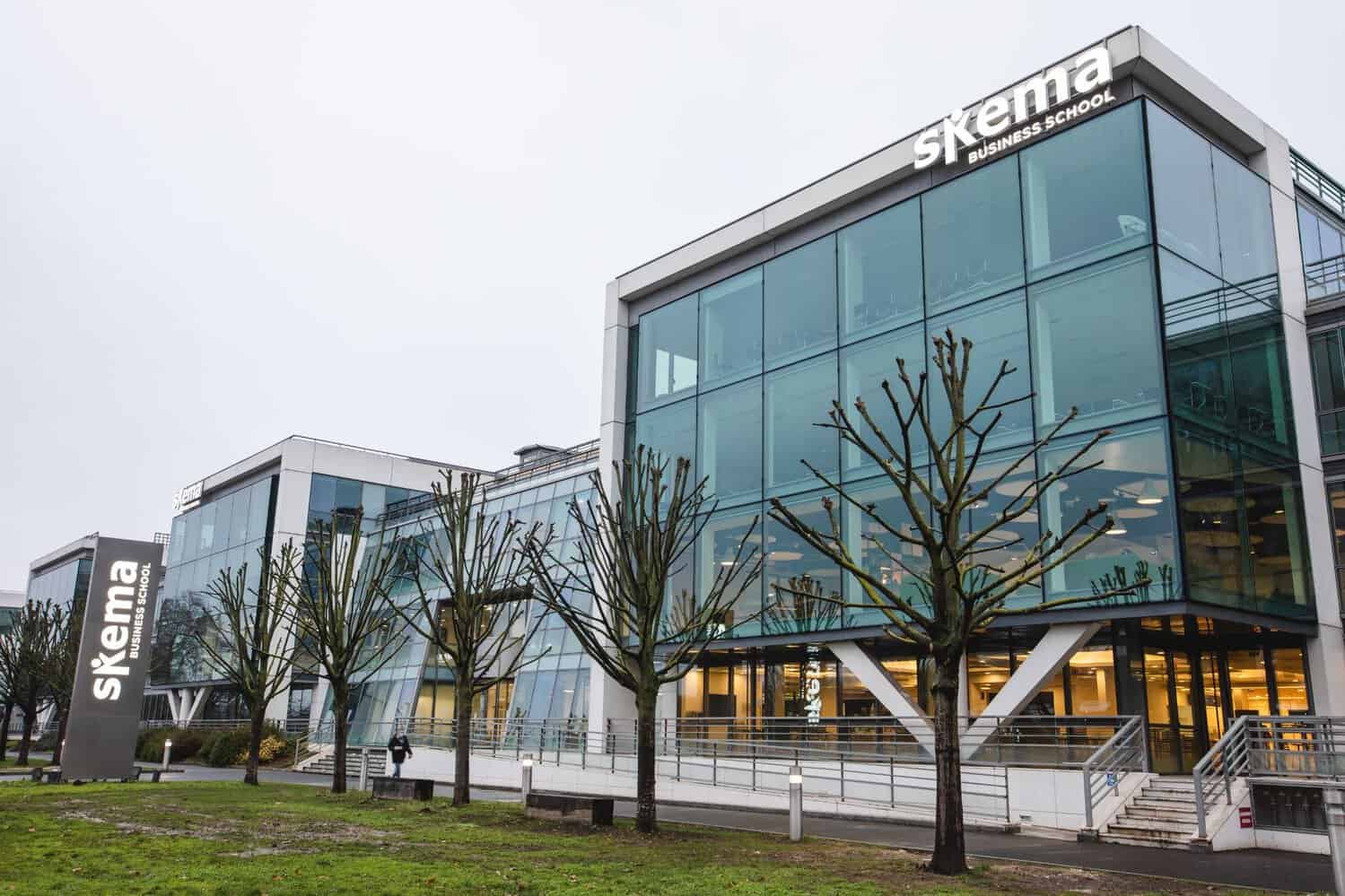
Another unique aspect of the MSc is that students have access to the knowledge and expertise of two top French institutions. On the one-year track, students spend the first semester on campus at SKEMA in Paris (a top-20 European business school), before transferring to ESIEA (ranked in the top 60 engineering schools in France) for the second semester.
“SKEMA brings strong competencies in strategic management, consulting, leadership, and international business environments. ESIEA contributes deep expertise in cybersecurity engineering, threat analysis, incident response, and digital forensics,” explain Ezzerouali and Haidar.
In addition to studying on two campuses, students graduate with a double degree from both SKEMA and ESIEA. While double degrees are common in the business school world, it’s rarer that two institutions with different specialisations offer one. Graduates of the MSc programme thus gain two alumni networks, expanding their future opportunities.
“This dual culture significantly enhances [students’] professional readiness and employability,” Ezzerouali and Haidar say, “particularly in consulting firms and regulated sectors such as finance, energy, and healthcare.”
Indeed, students can target a broad range of roles in varied sectors after the MSc, including:
- Cybersecurity Consultant
- Governance, Risk, and Compliance (GRC) Consultant
- Risk and Compliance Manager
- Data Protection Officer (DPO)
Not a technical degree or a business degree: Is this MSc right for you?
Given that this MSc connects technical and management topics, students from a wide range of academic disciplines, including engineering, IT, and business, are welcome to apply.
However, one thing unites all applicants. Primarily, you should be interested in applying your skills in big-picture strategy roles, rather than purely technical or operational areas.
“This programme is designed specifically for students who do not want to choose between technology and business,” assert Ezzerouali and Haidar. “It provides sufficient technical depth to understand cybersecurity risks and engage credibly with technical teams, while focusing strongly on strategy, governance, consulting, and leadership skills.”
The demand for cybersecurity professionals who can operate at this strategic level – and communicate effectively at the board level – has never been higher. The MSc in Cybersecurity Management and Consulting gives students the tools to pursue high-impact careers in a high-demand area – where you’ll lead from the front, not from behind a computer.
“It prepares graduates not only to understand cybersecurity problems, but to address them in a way that is meaningful, actionable, and aligned with organisational priorities,” say Ezzerouali and Haidar.
Want to hear what real students are saying about SKEMA Business School? Read the EDUopinions blog, or head to SKEMA’s EDUopinions profile.





Recent Posts

It's the time of the year when everyone's eyes are on the rankings tables, waiting to see which business school is going to come out on top. Most ...

Madrid runs on cheap metro rides, long lunches and free museum afternoons, which is a big part of why so many students end up here. Before you ...

France is an incredibly exciting study destination if you're interested in studying business. The country is home to 24 companies on the Fortune 500 ...

In the centre of a vibrant student city in Belgium, thousands of students gather on Thomas More University of Applied Sciences' Campus De Ham for one ...