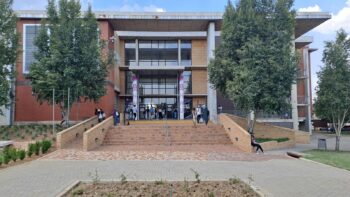

Walter Sisulu University
speciality:
Communication
What is a Communications degree?
Communications is a universal degree, which explores the traditional forms of communication such as verbal, physical, visual and written communication but also extends beyond that to cover mass communication and social media. There are different types of communications degrees depending on the degree level.
Overall, Communications focuses on teaching effective communication through social media, web, print, mass media and verbal communication. However, there are two types of Communications degrees that exist. For instance, a Bachelor of Arts in Communications in the US is focused on preparing students for careers that are connected to writing, marketing, promotions, journalism and public relations. In contrast, Bachelor of Science in Communications is dedicated to the technology used in the science behind modern communication and prepares students for careers in production or sound engineering.
A Communications degree teaches students about how media and communication influences cultures, societies and people’s identities. It involves a significant amount of critical writing and research and covers different disciplines such as journalism, public relations, entertainment production, marketing, event planning and so many more disciplines, which are somehow connected to exchanging information and conveying messages. There are also different specialization options associated with this degree, including political communication, mass media, journalism, health communication, etc.
It is worth noting that a Communications degree has many intersection points with psychology, sociology, linguistics and in some cases politics.
Benefits of a Communications degree
The main benefit of a Communications degree is its universal nature. It applies to almost any subject or professional setting. For example, some of the top careers in the field of Communications include announcers, art directors, editors, broadcast and sound engineering technicians, reporters, correspondents, broadcast analysts, technical writers, writers and authors, interpreters, translators, etc. Therefore, it keeps students’ career options open and doesn’t require them to have a predetermined career path that they want to follow.
Communications degrees prepare students to make an impact from the start of their careers unlike other degrees, which require further training. This is possible thanks to the multitude of professionally accredited degrees in Communications, which develop students’ abilities based on the established standards in the field. Moreover, there are many Communications courses, which offer work placement opportunities that enable students to gain the required professional skills before they have even started their career.
Another benefit associated with Communications degrees is the fact that they develop students’ written and verbal communication skills significantly.
A major advantage of Communications over other degrees is that in most cases there are no prerequisites required to study Communications.
Communications degree structure
The duration of a Communications degree varies depending on the country and degree level. For example, Higher Education Institutions in the UK offer 3-year Bachelor’s courses. In some cases, the course may extend to four years if students are given the opportunity to spend a year abroad or in industry between the second and third year through a sandwich course. Bachelor’s degrees in Communications in the US usually take around four years to complete.
Over the duration of a Bachelor’s Communications degree, students are expected to learn and be able to apply the established communications theories by developing the technical skills required to work in a professional setting. In the first year of their studies, students learn predominantly how media and communication influences cultures, societies and people’s identities. Optional modules may introduce them to professional communication, journalism, documentary, film-making, marketing, etc. In addition to the introductory topics, this degree allows students to learn about more complex areas of communications such as interpersonal relations, brand management and linguistics at a later stage. For instance, the second and third years enable students to get a deeper understanding of theoretical concepts related to media and culture and develop practical skills in research and communications. Additionally, students may have the opportunity to take optional modules and pursue their interests in different areas related to Communications such as gender, race, youth, culture, digital media, political communication, public relations, etc.
The most common duration of a Master’s degree in Communications is between 1 and 2 years depending on the mode of study (full-time or part-time) and country.
PhD and MPhil degrees in Communications require students to dedicate anywhere between 3 and 6 years to their studies depending on the mode and country of study.
5 Student Reviews
-
Information and ...3 months ago
 StudentZAWSU being unfair
I wouldn’t recommend WSU because they never take students seriously.They like to do things at their own desired time. They don’t care how the problem or a certain issue affects students. They only deal with issues that only affect them. For example. I’ve passed with distinctions but I still don’t have my confirmation letter. I’ve been sending emails and they just ignored them. Now I can’t even apply for jobs because of d them.
View more
They just decided to close the university without even solving this issue. I have to wait until January and job applications are closing.My future is at risk here and they don’t care.Programme: Information and Communication Systems EngineeringDegree: Bachelor'sGraduation: 2025Delivery Type: On CampusCampus: East London -
Advertising and ...4 months ago LihleZAWSU experience
I would recommend Walter sisulu university because it’s fun studying there, the lecturers are well trained and always ready to passby the knowledge, fair to students, give students the necessary study breaks, give students chances after chances. I dislike how they treat post graduates though in terms of students funds, student loans, unfair dismissal, certain restrictions but all in all its a great school.
View moreProgramme: Advertising and Public Relations + MarketingDegree: Bachelor'sGraduation: 2025Delivery Type: On CampusCampus: East London -
Communication and ...4 months ago
 AviweZAStudent experience
My opinion about WSU is that it is for the poor and the marginalized, I would highly recommend it as it offers a variety of support services for its students like academic advising, writing center which assists with assignment and research writing, it also offers peer to peer tutoring sessions. It also offers its students the opportunity to be employed within the school as tutor, Pals and residence mentors.
View moreProgramme: Communication and Public RelationsDegree: Bachelor'sGraduation: 2025Delivery Type: BlendedCampus: East London -
Communications and ...6 months ago StudentZAExceptional teaching and learning
The university is very good when it comes to teaching and learning and equipping students with the necessary skills for their courses/fields. In general, it’s reputation may seem a bit negative but for a student who really want to achieve the best skills and knowledge, it definitely the best to go
View moreProgramme: Communications and Media StudiesDegree: Bachelor'sGraduation: 2024Delivery Type: BlendedCampus: East London -
Communication and ...07 Mar, 2025 BaneleZAi think it's a very helpful to student's
In university, I really enjoyed the sense of independence and the opportunity to explore new ideas. One of my highlights was participating in group projects where we collaborated with classmates from diverse backgrounds, which really enriched my learning experience. I also loved attending lectures by guest speakers who were experts in their fields—they provided real-world insights that made the material more engaging.
Another highlight was joining clubs and organizations that aligned with my interests. Whether it was a debate club or a cultural organization, these activities allowed me to meet new people and develop valuable skills outside of the classroom.
I also cherished the friendships I formed during my time at university. Late-night study sessions, coffee runs, and spontaneous adventures on campus created memories I’ll always treasure. Lastly, the chance to study abroad for a semester was incredible; it broadened my perspective and gave me experiences I’ll never forget. Overall, university was a time of growth, exploration, and unforgettable moments!
View moreProgramme: Communication and Information SciencesDegree: Bachelor'sGraduation: 2022Delivery Type: On CampusCampus: East London