
- Prioritise career-focused schools like EADA Business School; 98% of Master’s in Management graduates employed within three months and strong FT career progression ranks.
- Build practical soft skills through simulations, group projects and modules at the EADA Residential Training Campus; recruiters value teamwork and clear communication.
- Use the Careers Centre, networking events like Talent Day and tools such as CareerOS early to target roles and leverage alumni.
Across Europe and beyond, business school applicants are increasingly selective about where they invest their time and money. Almost half (48%) of all business school candidates research employment outcomes and business school careers before choosing a school – a rise of 8% in just two years.
Yet across Europe and beyond, the value of a business education continues to grow as graduates seek international careers, faster progression, and access to global employers. This makes employment-focused business schools more relevant than ever – particularly those that combine academic excellence with strong company connections and practical experience.
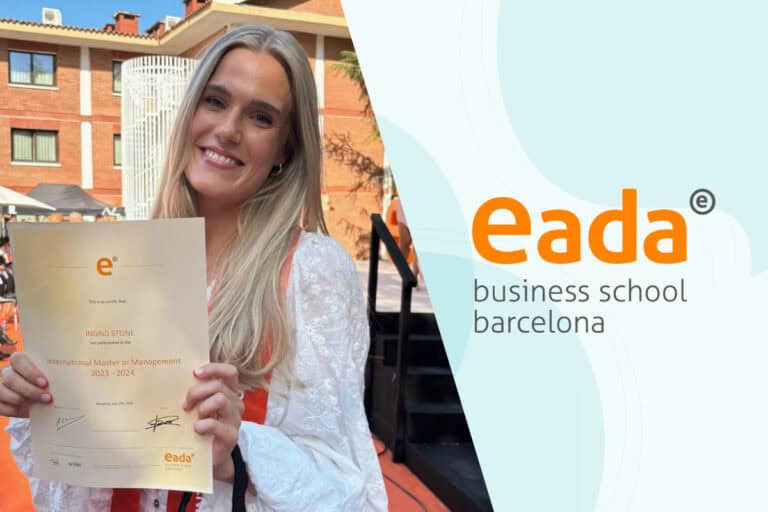
Notably, 98% of Master’s in Management graduates at EADA Business School in Barcelona are employed within three months of graduation – including international  students like Ingrid Steine.
Ingrid moved from Norway to Spain to study the Master’s in International Management at EADA Business School. “I was drawn to EADA for its strong mix of academic quality and clear focus on employability,” she says. After graduating in July 2024, Ingrid started her graduate career at the global research and advisory firm Gartner in Barcelona.
We spoke to Ingrid about her EADA journey and her tips for boosting your chances of career success at business school.
Choose a career-focused school
EADA Business School checks all the boxes for students concerned about employability. The Financial Times recently ranked the school 13th globally for career progression, beating other world-renowned business schools in the UK, Germany, and Italy. The school’s Master’s in Management also ranked 17th for international work mobility.
Master’s in Management students at EADA start their professional development early by choosing from in-depth programme specialisations in digital business, strategy and consulting, entrepreneurship, or business analytics.

The multicultural environment at EADA – where up to 98% of students on some programmes are international – also contributes to the school’s focus on jobs. “EADA’s highly international environment allows the school to provide tailored career support for both students seeking opportunities in Spain and those targeting international careers,” explains Melissa Handley, Careers and Talent Director at EADA Business School.
“The EADA Careers & Talent team has also proactively developed relationships with companies and recruiters across twelve different countries as part of a strategic business development initiative,” Melissa adds.
“The Master’s in Management at EADA offered the right balance between academic learning, practical experience, and personal growth,” notes Ingrid.
Build practical skills during your studies
For most business school recruiters, it’s not enough that graduates have a solid grasp of theory. Increasingly, they’re looking for those who have developed soft skills through practice. As a result, students should prepare themselves for intensive projects at business school.
“Working on group projects, managing tight deadlines, and learning how to structure and communicate solutions clearly closely mirrors how work is done in a professional environment,” says Ingrid.
It’s partly for this reason that Ingrid was drawn to EADA, which positions soft skills as a core part of the programme curriculum. For example, Master’s in Management students participate in two-day modules at the EADA Residential Training Campus in Collbató, where they test their leadership and communication skills in intensive group settings.
On campus in Barcelona, meanwhile, students combine classroom theory with practice through business simulations, group projects, and company visits.
“One of the most valuable skills I developed was confidence in presenting and communicating ideas clearly,” notes Ingrid.
“That foundation has been especially important in my current role, where I work closely with senior stakeholders and C-level clients and apply these skills on a daily basis. This has been key to helping me adapt quickly in a fast-paced professional environment.”
Recruiters notice these skills in EADA graduates, too. “The Careers & Talent team works closely with recruitment partners and from their feedback, we know they highly value our students’ ability to work well in teams, their proactive attitudes and their willingness to roll their sleeves up and get the job done,” explains Melissa.

Take advantage of career services
Your business school’s career service department should be one of the first places you go to for support and guidance about future roles. Unfortunately, many business school students delay (or procrastinate) accessing these services until the end of their degree – when it may be too late to get the full range of support.
“Many students focus on academics, and the risk here is that career preparation can be ‘postponed’,” notes Melissa. “EADA encourages students to approach career development with the same level of dedication as their academic studies, from day one. Students are trained to set goals, actively engage with networking opportunities, and continuously develop their professional profiles.”
Early on in her Master’s in Management, Ingrid approached EADA’s Careers Centre for help with identifying potential employment. “I worked with the Careers Centre to define my goals and narrow down the types of roles and companies that best fit my profile. That gave me a clear direction and helped me approach the job search much more strategically,” she explains.
One of the tools that students have access to through EADA’s Careers Centre is CareerOS, a portal that connects students with networking opportunities, job openings, and AI-powered tools for tracking recommendations and creating a powerful resume.
Network widely
Networking can feel daunting at first, especially if you’ve arrived at business school from a non-business academic background. However, both Melissa and Ingrid attest that networking is one of the most important tools for business school students.
“My top advice is to be proactive and make the most of every networking opportunity,” Ingrid says.
“The importance of networking can be underestimated,” adds Melissa. “Not all students are as comfortable as others in building their networks, and this is key today for a successful career.”
One of the most important networking events for students at EADA is the annual Talent Day. At the most recent event, EADA hosted 138 recruiters from 55 companies, including Revolut, Danone, Bayer, and Ingrid’s current employer, Gartner.
Ingrid also highlights extracurricular opportunities and student groups, such as the Consulting Club, as helpful in introducing her to a wider range of consulting pathways.
The foundation of successful business school careers

It’s not just EADA’s Master’s in Management programme that helps secure top jobs for students like Ingrid after graduation. The school’s Master’s in Finance programme has a 97% employment rate, with students securing roles at companies such as BNP Paribas CIB and EY.
The fact that EADA has an extensive alumni network spanning some of the world’s biggest companies is also a big help, says Ingrid.
“I encourage students to leverage the EADA alumni network. Everyone I’ve connected with has been incredibly generous with their time and insights, and those conversations can provide valuable guidance and open doors you might not have considered.”
So, what’s Ingrid’s biggest tip for prospective or current students? “Building relationships early is key to understanding the local job market and often leads to opportunities that aren’t advertised publicly,” she says. The key to these relationships might just start with your business school’s careers service.
“Throughout the process, I had consistent support from both the Careers Centre and my professors, which made navigating a competitive job market much easier,” Ingrid asserts.
Related Posts :





Recent Posts
Across Europe and beyond, business school applicants are increasingly selective about where they invest their time and money. Almost half (48%) of ...

A pharmacy degree is a great choice for healthcare students who want to keep their options open. Pharmacology and pharmacy degrees don't just lead to ...

The Times Higher Education World University Rankings 2027 are here, but there's something missing from the methodology – the students themselves.
...

– While an exciting curriculum, vibrant location, and busy student life are all important parts of your study abroad experience, it’s just as ...