
- Borderless education: Schiller offers a single US‑accredited degree while students study across campuses in Madrid, Paris, Heidelberg, and Tampa.
- In‑demand global skills: International mobility cultivates analytical thinking, resilience, leadership, and cultural intelligence employers seek.
- Hybrid global careers: Programmes blend American flexibility and European context with internships and partnerships for practical, transnational work readiness.
In the 20th century, the goal of higher education was simple: get into a good university, graduate, and find a stable job. But the world of education is different today. The careers students will have tomorrow don’t necessarily exist today, and the workplaces they’ll enter are increasingly global and fluid – especially with the rise of remote working. As a result, students and education institutions alike are realising the value of an international university experience.
Traditional borders, both geographical and academic, are dissolving. The future of higher education lies not in any single country, but in its ability to connect ideas, people, and opportunities globally.
Few institutions embody this shift better than Schiller International University, a global university with campuses in Madrid, Paris, Heidelberg, and Tampa. Its learning model, which allows students to move freely between campuses while earning a single, US-accredited degree, offers a glimpse of a future education system that is borderless.
Teaching In-Demand Skills for the Future
When Schiller was founded in the 1960s, few universities considered mobility an educational goal. The one-campus experience became the norm. However, today, students are seeking a university degree that prepares them for the global business world. Can the one-campus experience do that?
Employers are increasingly seeking new hires who can embody transferable soft skills alongside technical ability. In fact, the most sought-after skills among employers today are:
- Analytical thinking
- Resilience, flexibility and agility
- Leadership and social influence
Notably, employers also rank creative thinking as more important than technological literacy.
If students wish to gain these in-demand skills, they need to think beyond the one-campus experience. In particular, they should consider incorporating an international experience into their studies.
Moving between countries is about more than changing scenery for a short time. It means adjusting to a new language, learning systems, and social norms – all while studying with people from around the world.
As a result, studying abroad is a crash course in flexibility, cultural intelligence, and independence – skills that employers are increasingly seeking in graduates.
Student Review

I have been studying International relations and diplomacy at Schiller for two years. Schiller has very efficient Professors and I have learned a lot from each course. I like their system which needs every student to write a research paper related to their course every month. My analytical skills, critical thinking and knowledge in international relations and diplomacy have improved a great deal.
The Rise of Hybrid Global Careers
Education is no longer preparing students for jobs that exist solely within national borders. A marketing graduate might work remotely for an agency in another country. A diplomacy student might coordinate international policy projects online. A hospitality manager might lead multicultural teams across continents.
Schiller’s approach aligns directly with this reality. Its programmes – from International Business and International Relations to Hospitality and Tourism Management – are designed to reflect how global industries now operate.
One of Schiller’s most unique qualities is its hybrid academic identity. Degrees are US-accredited, meaning they are globally recognised, but the learning environment is unmistakably European.
This combination bridges two high-quality educational systems. It allows students to benefit from the flexibility of American education while living in global cities known for their history, creativity, and international influence.
Additionally, internships and partnerships connect students with organisations across Europe and the US, providing them with practical, international experience before they graduate. It’s a model that blends academic theory, digital skill-building, and cultural immersion into a single continuous experience, preparing you not just for a career, but for a global life.
Student Review

I am grateful to Schiller International University for providing me with the opportunity to pursue my education, even as an international student. The experience has not only enriched my academic knowledge but also broadened my cultural perspectives. I am sincerely thankful for this opportunity and delighted to have successfully completed my degree at SIU.
Multi-Campus, Not One-Campus
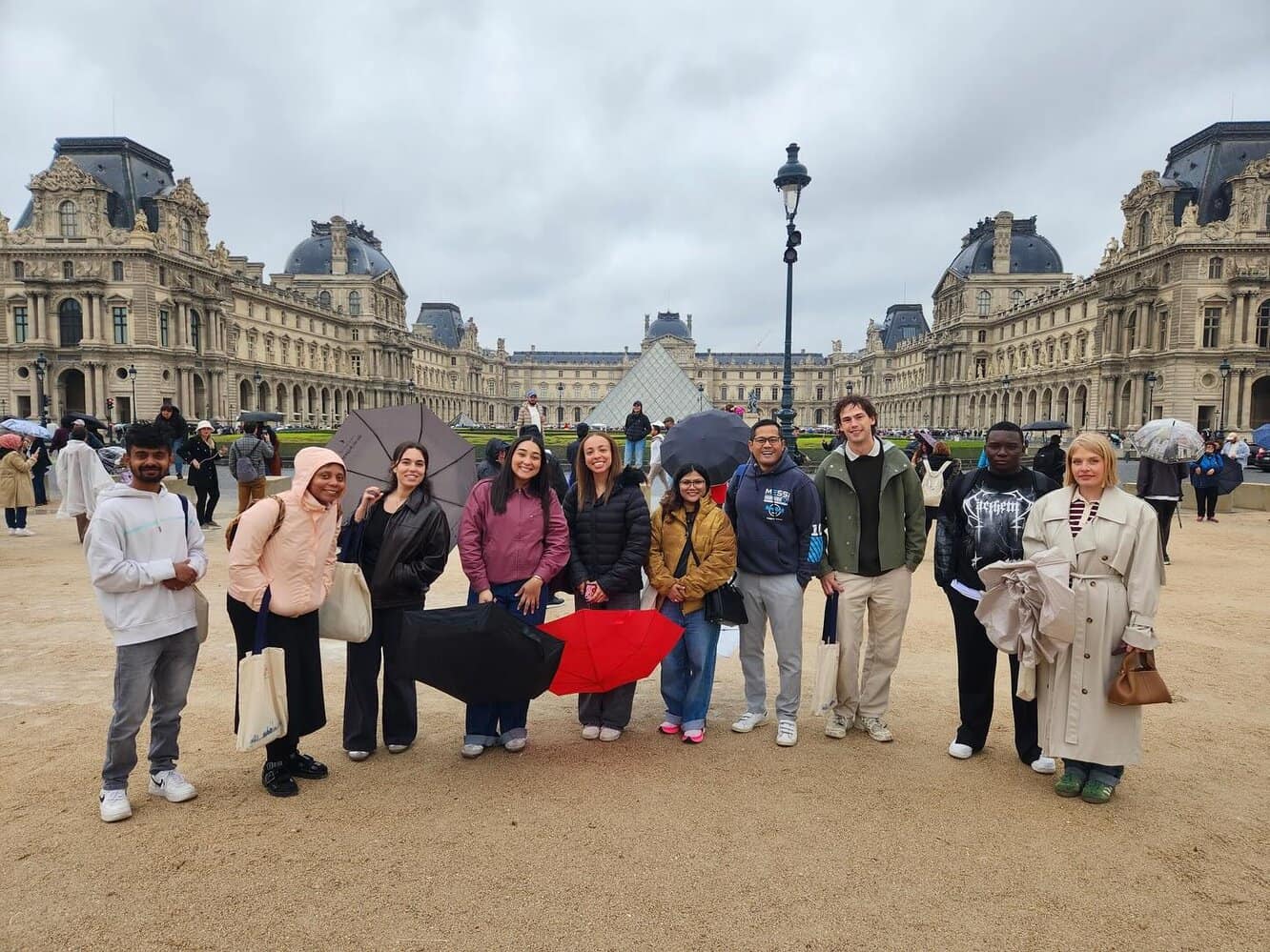
For most students, studying abroad means spending a semester in a foreign country before returning to their home university for the remainder of their degree.
However, at Schiller, you aren’t tied to a single city or country; instead, you’ll move through multiple educational, cultural, and professional environments during your degree. As a result, the learning experience is built around acquiring the key global skills necessary today and in the future.
Each of Schiller’s four campuses immerses students in a different cultural and professional ecosystem:
- Madrid: with its cultural energy and entrepreneurial spirit.
- Paris: a hub for diplomacy, culture, and international organisations.
- Heidelberg: steeped in academic history and European tradition.
- Tampa: representing the American business and innovation mindset.
By moving between them, students learn to adapt their communication, thinking, and work habits to fit different cultural contexts, a skill no textbook can teach but every employer demands.
For example, you might start your degree in Madrid, move to Paris the following semester, and finish in Heidelberg or Tampa. The curriculum follows seamlessly, so credits transfer automatically, and courses are taught in English at every location.
Student Review
I would recommend this university for people who would love to get both American and UK degree and you could live in 4 different countries(Spain, Germany, France and the US). I personally studied in Madrid. My experience was very pleasant, the teachers are very nice, always willing to help you. People studying there are also very nice and come from different countries which makes the atmosphere very interesting since you learn a lot about other cultures. Nobody gives you pressure, which makes studying pleasant and doesn’t stress you out all the time. I studied international relations and politics. Professor Shaw was very nice to listen to, taught us a lot. Also what I liked a lot is that we had many different classes such as economics, business, language classes, which is very diverse. The campus was quite small when I studied there 3-4 years ago but now I think they expanded it and now have a big campus. I am quite satisfied about my experience there, so would recommend this university to others.
Student Review
I feel that it is a great opportunity and for Americans to travel and study abroad to expand multicultural and perspectives.
This being the fact that we Americans can get some tuition assistance.
My experience with professors that have practical and enduring experience in their respective fields, plus ongoing activity in external organizations that impact my career area.
Learning Across Cultures and Industries

At Schiller, students from over 130 nations study together, exchanging diverse viewpoints that often challenge and enrich their understanding of the world. This diversity transforms group projects into real exercises in diplomacy and communication.
When classmates bring perspectives from Brazil, Nigeria, Germany, and India to the same discussion, learning naturally extends beyond the syllabus.
Schiller brings learning into the classroom in other ways, too. The university’s partnerships with international organisations, NGOs, and corporations ensure that students learn not only from each other but also from professionals.
Guest lectures, case competitions, and collaborative projects connect classroom learning to real-world practice. Business students might analyse global market data with corporate mentors; international relations students might collaborate with humanitarian organisations on field research.
This hands-on approach keeps the curriculum relevant while giving students the professional network and practical experience they’ll need after graduation. It also reflects the broader shift in higher education: from theoretical knowledge to applied, impact-driven learning.
Student Review
I would recommend this university for its multicultural environment. Everyone can get a dual degree – American and English. This university has campuses in Madrid, Heidelberg, Paris and Tampa. Very good atmosphere
Borderless Education, Borderless Thinking
What employers and students increasingly demand is a borderless approach to skills acquisition and business education: the ability to connect disciplines, cultures, and technologies, and the willingness to move, adapt, and collaborate across borders.
In the coming decade, universities that can’t offer international exposure or technological integration will struggle to meet student expectations. The next generation doesn’t want to choose between travel and study, theory and practice, or physical and digital learning. They want – and need – all of it, woven together.
The concept of a ‘global citizen’ has become something of a cliché, but for Schiller International University students, it describes a lived reality. They study in multiple countries, work on projects with peers around the world, and graduate ready to navigate any environment.
Consequently, Schiller offers a model for the future, one where students can earn an American degree, study across Europe, and learn to collaborate in both digital and physical spaces, preparing them for a borderless future.
The world no longer operates within borders, and neither should education. The universities that will define the next century are those that prepare students to think, work, and live globally.
Related Posts :



Recent Posts

We created the EDUopinions Student Reviews Guide to highlight students' opinions of universities. All of the rankings we produce as part of the Guide ...

The University of Pécs in Hungary ranks among the top 1,000 universities in the world, and in the top 300 in Europe. Located in one of Hungary’s best ...
Want to boost your skills with an MBA, but don’t want to take time out from your job to study – or move abroad? An Online MBA means you can study the ...
North-West University is globally recognised for its strong teaching and research; it is ranked seventh in Africa and among the top 1,000 ...