
- Erasmus+ supports student mobility with €26 billion funding for exchanges until 2027, enhancing educational experiences across Europe.
- Participants receive a grant for living costs; exact amounts vary by country, duration, and factor in initiatives like a €50 green travel stipend.
- Eligibility covers EU students and select non-EU countries; UK students are not eligible for Erasmus+ programmes post-Brexit.
Ever wanted to study abroad and get money to do so? Studying abroad with Erasmus allows you to do just that.
Erasmus+ is a programme organised and funded by the European Union that allows students from across EU countries to participate in study exchanges with other universities. Your exchange can be for a short duration or up to a full year, allowing you to explore a new culture and add to your overall university experience.
Plus, employers look favourably at graduates who have spent some time abroad.
But how do you apply for the programme? Who is eligible? And how does it work? Here’s our full guide to studying abroad with Erasmus+ – including real feedback from students who have participated in a study abroad experience.
What is Erasmus+?

The Erasmus+ programme has been running for over 35 years (since 1987!). The current programme started in 2021 and will run until 2027, with €26 billion set aside to support student mobility and learning experiences.
Erasmus isn’t just about studying abroad. The programme funds lots of other educational projects, including traineeships in different countries and Erasmus Mundus Joint Masters degrees that offer an in-depth curriculum created and taught by multiple European institutions. However, the project is most well known for its study exchanges, offering thousands of students every year the chance to explore a new destination as part of their undergraduate or postgraduate degree.
The study exchange you participate in should be in an area relevant to your degree. For example, you can’t study a different study programme at your exchange university. During an exchange, you’ll continue to pay tuition fees to your home university, even though you’re not actively studying there.
Do I get paid to study Abroad With Erasmus+?
Students studying abroad with Erasmus get a grant to contribute to their living costs while abroad. Grant amounts will differ depending on your home country, destination, and exchange duration – but be aware that the grant may not cover all your living costs! For this reason, you may still need to look for a part-time job while you study abroad.
Erasmus has a grant simulator that can help you estimate how much money you’ll receive as a stipend for your study abroad experience. For example, a student from France attending an exchange in Denmark for three months can expect to get approximately €1,583 in grant money.
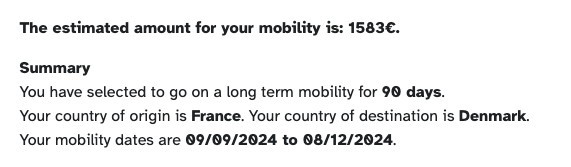
This total includes a €50 green travel stipend for taking the bus or train to your exchange destination. This is part of the EU’s project to make Erasmus+ exchanges more environmentally friendly.
💡 There are additional grants students can apply for. For example, you may get more grant money if you qualify as a person with “fewer opportunities” because of a disability or other factors. Make sure you’re applying for all the grants you’re eligible for!
Who can participate in Erasmus+?

There are very few limits to who is eligible for Erasmus+ study exchanges. The main requirements are:
- Individuals must be from an EU member state (or an eligible participating country such as Iceland, Liechtenstein, North Macedonia, Norway, Serbia or Türkiye) and,
- Registered in a higher-education institution and,
- Qualify under language requirements at the destination institution.
Since the United Kingdom is no longer a member of the EU, students from the UK are not eligible for Erasmus+ study abroad opportunities. Additionally, universities in the UK are no longer destination options for EU students for their exchange programmes. Even with the UK’s exemption from the Erasmus+ programme, there are still plenty of opportunities at partner universities in Europe!
💡 You can study abroad with Erasmus multiple times during your degree, but your time abroad can’t exceed 12 months over the entire duration of your bachelor’s or Master’s degree.
How to Study Abroad with Erasmus

Your first step to studying abroad with Erasmus is to check if your home university has the right agreements in place with partner universities that can host you. If they do, then you can start your application!
The application process will include both your home university and the university where you want to complete an exchange. First of all, you should contact your home institution’s Erasmus+ or International Office and enquire about opportunities in your study programme.
Some institutions have specific periods throughout the year when students can apply for an Erasmus+ exchange. So, to ensure that you can study abroad at your desired time, look up deadlines as early as possible!
Institutions have their own limits on how many students can go on exchange each year. If there are too many applications for the places available, then your home institution will review all applications and make a selection. They might review your GPA, previous experience, study options, and potentially a motivation letter to decide.
If your application to study abroad with Erasmus+ is approved by your university, you’ll sign an online Learning Agreement which recognises that the credits earned on your exchange will be valid for your current study programme.
If you’re successfully selected for an exchange experience, you’ll receive access to Online Language Support (OLS), a tool that will help you study your destination country’s language before you arrive. This can help you feel more immersed during your exchange and make the most out of your time abroad!
If you have any questions about the Erasmus+ programme or the application process, you should seek help from your university’s International Office.
Reviews of Erasmus from EDUopinions
So, what do students who have participated in an Erasmus exchange have to say about the experience? Overwhelmingly, students loved their Erasmus experience – particularly the opportunity to experience a different institution and country.
However, a minority of reviewers found the organisation of their Erasmus+ exchange difficult, while others didn’t enjoy their time at their host university. Our advice? Do your research on your host university carefully (maybe by reading student reviews on EDUopinions!) to decide if it’s the right experience for you.
Student Review of Technical University of Dortmund, Germany

I was here for erasmus program. The whole people involved in the exchange was very nice and helpful. They gave the best experience for me when I was there. They told me to not be too nice and complain if anything bad happened to me, I did not do that but my buddy program understood her task and immediately tell the International Office. Wonderful experience!! The classes provided was also eye-opening especially coming from a third world country.
Student Review of Aix-Marseille University, France
I have spend one semester at the university of Aix-Marseille and all in all, I really liked it.
I mostly attended special courses for Erasmus students which were really nice and not suitable regarding the language level. Also, the professors were really nice. However, the organization was not that good as in my home university in Austria. But in the end everthing worked out.
Student Review of Université Paris Nanterre
I hated my time as an exchange student here. Accessing the portal for all the emails is difficult enough. Other than in the fete courses they don’t really care about exchange students. Teachers never respond to emails, students are closed off and don’t interact with Erasmus students. The teachers talk too fast and it’s difficult to integrate yourself. I wish I could leave sooner.
Student Review of Aalborg University, Denmark

As an Erasmus student at Aalborg University, my time here has been nothing short of amazing. The university’s commitment to an inclusive and welcoming environment for international students made my transition seamless. The Erasmus program at Aalborg University goes beyond academics, emphasizing cultural integration and mutual understanding. The support from the International Office, faculty, and fellow students made me feel at home in a new country. The courses offered under the Erasmus exchange are well-structured, providing a perfect balance between academic rigor and cultural exploration. Aalborg’s vibrant city life, combined with the warmth of its people, has made this experience unforgettable. I am grateful for the lifelong friendships formed and the valuable insights gained during my Erasmus journey at Aalborg University.
Student Review of CETT, Spain
CETT University was a great place to go for an Erasmus. I met a lot of different students from different nationalities here. I enjoyed my semester as I enjoyed living in Barcelona for 5-6 months. It was a great experience. The campus was huge. I like the cafeteria. It gets really cold in the classroom during winter and some professors don’t like to open the heater. Some professors were a bit arrogant, some were nice. I had a lot of fun, especially with the course that I had because visiting the museums in Barcelona was part of my course for some subjects. If I could go back in time, I would still choose CETT University to be my option to go for a semester abroad.
Conclusion
The Erasmus programme offers students an incredible opportunity to leave their home university and study in another part of Europe (or the world) for a short time. During your exchange, you’ll meet new people, explore a new culture, and study modules that will help strengthen your study experience – and gain you better job prospects after you graduate.
If you’re considering studying abroad with Erasmus, read your host university’s application process to check deadlines and requirements. Your exchange destinations may differ depending on your institution and the universities they partner with.

Related Posts :






Recent Posts

We created the EDUopinions Student Reviews Guide to highlight students' opinions of universities. All of the rankings we produce as part of the Guide ...

The University of Pécs in Hungary ranks among the top 1,000 universities in the world, and in the top 300 in Europe. Located in one of Hungary’s best ...

Want to boost your skills with an MBA, but don’t want to take time out from your job to study – or move abroad? An Online MBA means you can study the ...

North-West University is globally recognised for its strong teaching and research; it is ranked seventh in Africa and among the top 1,000 ...