
Student review [#90369]
for Mathematics and Computer Science
at École Polytechnique Paris
Palaiseau, France

TL;DR – Despite a heavy workload, the BX program allows you to meet amazing people as well as gain incredible amounts of knowledge and experience while being an amazing launchpad for graduate education.
Studying in the Bachelor of Science of École Polytechnique is a journey, in the good sense. To start with a bit of background, we are a cohort of about 140 students, of whom approximately half are francophone (French people that lived around the globe + people from Northern Africa and Lebanon), and half from dozens and dozens of countries (with the most prominent ones being Romania, Russia, Serbia, Poland, Germany, Spain, Italy, India, China, Vietnam, Brazil and maybe a few more). Students have a very high academic level, despite some variance.
Over the first year, you learn to cope with the high-workload of the program. You discover the basis of mathematics through Analysis, Linear Algebra, and Calculus (roughly the program of “prépa”). Meanwhile, you also study Computer Science, Physics, and Economics—all at a less intensive rate. Second-majors are beginner-friendly, but their difficulty ramps up very quickly. In parallel, you make friends, join the « bachelor family », and join committees. Depending on the student board and the time of year, there are also parties to attend and fun events to take part in. In addition, there is a campaign week full of fun activities where first-years compete to be elected as student board. It is perfect to add 24/24hr crêpes to your study sessions, or have fun in bouncy castles as if you were four. These are nonetheless all still side activities as the Bachelor program requires you to keep working continuously if you want to keep a high GPA.
During the second year, this is when work really starts to kick in (at least for me). After experimenting during the first year, you are a bit more comfortable with your routine, but can still struggle to maintain a healthy lifestyle. After choosing a major (Math + CS/Physics/Econ), courses become harder and the ~3 core courses per major really start to stack up. Meanwhile, you often have to deal with academic problems. Whether it is about poor organization, grading scales, or other questionable rules, you will feel like losing your mind at some point. Don’t panic though; it is still fun, you are always surrounded by friends, and the study environment is nice.
The third year is split into three parts. Over the fall, depending on motivation and GPA, about half of the students go on a semester abroad. For those who stay (from what I have heard), it is pretty similar to the second year. For those who go, it is always an incredible experience. You get to discover an amazing country and university while having the opportunity to travel. Students usually enroll in third year and master’s classes and the general sentiment is that the workload is lighter than in the Bachelor Program. Following the semester abroad, over the winter, you also write a Bachelor’s thesis which consists of an 8-10 week research internship in a lab or a company. It is usually a very nice experience where you get to work on what you like best. Lastly, over the spring, you get a few more courses before graduation. By this point, students usually know what they are going to do the following year so everyone is pretty chill. Everyone is rejuvenated by their experiences and glides through the last few months simply enjoying the improving weather, campaign week, and the various fun events. There is still work, but by this point people are acquainted with the style of classes and are much less stressed than before.
After graduation, people go all over the world in the best programs and universities to continue what they like best. Overall, in three years, you will have met a set of amazing people, learned enough to pursue any MSc or PhD track, have had plenty of research or industry experience, maybe have gone on a semester abroad on the other side of the globe, and probably been accepted to a top university in the postgraduate program of your choice.
F.A.Q
Is it that much work ?
It can be a lot at times but is reasonable in my opinion overall. It also depends on who you are and what you want. If you are looking to pass the year with a decent GPA, you’ll be fine with working a decent though not crazy amount of time. If you are aiming for the first quartile, chances are you’ll have to put a lot of effort in, of course depending on your comparative base level. You’ll have to do some late-night study sessions, some days stuck in the library, but you’ll still have some time to hang out with friends and go out often enough.
What’s the campus like ?
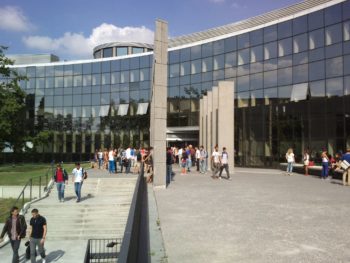
The campus is nice. Some parts are outdated, but ongoing renovations should slowly solve that problem in the coming decade. You are in a small student city in the middle of nowhere, which is 20km south of Paris—1hr from the center in RER and 30 min by car. There are sports facilities which are almost always accessible and free of charge. Building 103 really feels like home, as it is where all bachelor students live. You have a nice private bedroom and bathroom with a kitchen shared among four students. The only notable downside is that common areas are poorly maintained.
How would you compare it to a “prépa” ?
The Bachelor program has a very different objective than prépa. The goal is not to prepare you for a set of written and oral exams, but to give you the theoretical and practical foundations and experience to pursue any graduate program you desire. Over three years, you get to have much more experience. You have the opportunity to do three summer internships, one research internship, one research project class, go on a semester abroad, all while acquiring industry-ready skills. In comparison, after two (or three) years of prépa, you may (or may not) have entered the school of your dreams, and will have had no experience whatsoever. Academically speaking, our mathematics curriculum during the first two years of the program (and I guess physics for Maths-Physics students) closely resembles the prépa one. As we also study applied topics, I think that we go slightly less in depth, but we still acquire all of the necessary bases for further study. In terms of workload, I believe that we have less work than prépa students. There is still a lot of work, but it is hard to compare any workload to those of students in the best prépas.
What is your relationship with Engineering students ?
We usually have a chill relationship with engineering students. Most of them don’t mind us, and some are close friends. We study in the same places, share some professors, and have a pretty similar life, except for the fact that we don’t live in the same building. Your engagement with engineers depends mostly on you. You can join “binets” (engineer’s version of committees), go to their parties, and become close friends with them. If you want to never talk to a single engineer over the whole three years, it is also possible. Nonetheless, one thing to remember is that you are not an engineering student. You don’t have military status, you don’t parade on the 14th of July, and you don’t have an engineering degree.
Who gets to go on exchange ? Can I go wherever I want ?
I think the semester abroad generally follows the same distribution : 80% of students would want to go abroad, 70% of students have the minimum requirements to go abroad, and 50-60% end up going abroad. There are two types of universities in which you can go: the partner ones and the non-partner ones. Partner ones have an agreement with École Polytechnique, whereas non-partner universities can be any institution outside of France. From the top of my head, partner universities are, organized by region: McGill, UToronto, Dalhousie, Brown, UChicago, UC San Diego, UC Berkeley, Monterrey, Católica de Chile, ETH Zurich, EPFL, DTU, King’s College London, TUM, PoliMi, Bocconi, Kaist, Peking University, HKU, NTU, Taiwan National University, UoMelbourne), there is only an internal selection, and you pay as if you were still at École Polytechnique. You can also consider any institution which has a semester abroad program and courses in one of your major. Examples include the University of Oxford, Harvard, UPenn, and Columbia University. In any case, there is an internal selection process based on your GPA, a motivation letter, and a wishlist. As a side note, students in the X-Columbia BS/MS program do not participate in the semester abroad.
Can you work directly after graduation ?
Most students don’t work directly after graduation, even though it is definitely possible. In France, it is much harder (except maybe in entrepreneurship) to work with only an undergraduate degree. So most people that don’t go to postgraduate programs usually either do a six-month or one-year internship before applying to MSc/PhD programs or start working internationally as Software Engineers, Data Scientists, Quantitative Traders/Researchers, Investment Bankers, etc.
Where do people usually go for Master’s ?
If you are roughly in the first quartile (best 25% of students), you can pretty much aim for any program in any university. Then, in the second and third quartiles, you can get into very good programs but it will be a bit more up to luck and experience. In the last quartile, students usually go for programs that are less competitive but still very good in essence. Taken from a non-exhaustive alphabetical list, past students have gone in America to CalTech, Carnegie Mellon University, Columbia University, Cornell Tech, Harvard, MIT, Princeton, Stanford, UC Berkeley, UChicago, Yale, in Europe (excluding France) to Bocconi, Cambridge, DTU, King’s College, KTH, EPFL, ETH Zurich, Heidelberg University, Imperial College, London Business School, LSE, Oxford, Saarland University, TU Delft, TUM, University of Bonn, and in France to CentraleSupélec (Engineering program), Chimie ParisTech, Dauphine Paris, École Polytechnique (Engineering Program and MSc&T program), ENS Ulm, ESCP, HEC Paris, INSEAD, IP Paris (PhD Tracks), Isae-Supaero, PSL, Sciences Po, Université Paris Dauphine, Université Paris-Saclay.