
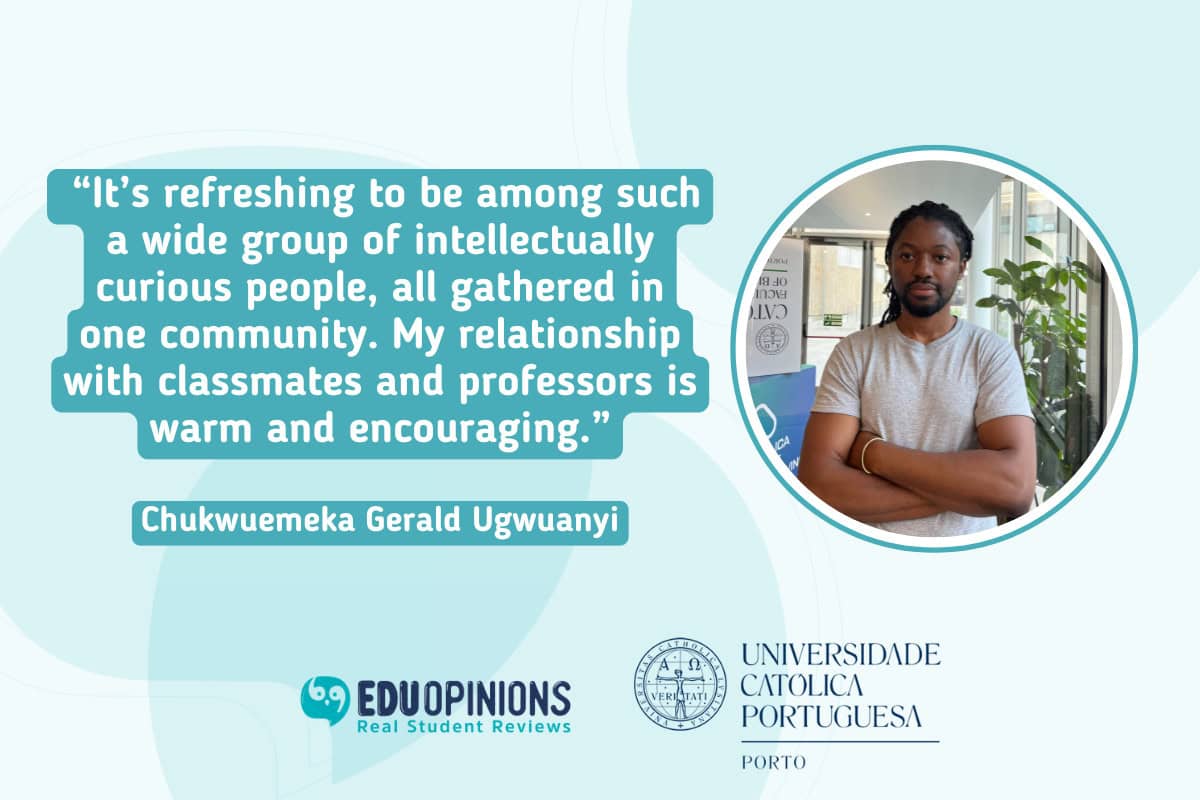
- Chukwuemeka Gerald Ugwuanyi, a 38-year-old Master’s student, studies Biomedical Engineering at Universidade Católica Portuguesa.
- His goal is to return to Nigeria and enhance the underdeveloped field of Biomedical Engineering.
- The academic environment at Católica fosters supportive relationships between students and professors, enhancing learning.
- Chukwuemeka highlights the importance of research as a long-term investment that transforms lives and generations.
Chukwuemeka Gerald Ugwuanyi is a 38-year-old Master’s student in Biomedical Engineering at the School of Biotechnology of the Universidade Católica Portuguesa. Enthusiastic about the course curriculum, Chukwuemeka Gerald Ugwuanyi came from Nigeria to study at Universidade Católica Portuguesa to deepen his knowledge so he can eventually move into research.
His future plans? To return to Nigeria to contribute to the development of the Biomedical Engineering field. His favourite place in Porto? The beach!
Hear more about Chukwuemeka’s experience of studying at Universidade Católica Portuguesa in our exclusive Q&A.
Q&A with Chukwuemeka, student at Universidade Católica Portuguesa – Porto
You are studying for a Master’s in Biomedical Engineering at the School of Biotechnology. Why did you choose this master’s?
In Nigeria, I studied Electronic Engineering. Before coming to Porto, I worked as a software engineer in the field of health technology. Within Biomedical Engineering, I am especially interested in Tissue Engineering and Neuroprosthetics.
I chose this master’s because the curriculum really motivated me. Biomedical Engineering is a very broad field and, depending on the institution, it can have a stronger focus on physics or electronic engineering, with the clinical and biological side as more of a complement.
In the case of Católica, as the master’s is offered by the School of Biotechnology, the focus is on the biotechnological component. It’s a unique programme. Of course, there are also subjects from the field of engineering, but the curricular structure is very much centred on biotechnology, with many professors and researchers from that area.
How did you find out about the Universidade Católica Portuguesa – Porto and the master’s you’re studying?
Mostly through the website. The information was very clear, both about the curriculum and the professors. There were also practical details about tuition fees and the academic calendar, which really helped in making the decision.
I also exchanged a few emails with the academic services team, who were very helpful and clarified all my questions. In the end, it was a very pleasant surprise for me.
I didn’t even know the city of Porto. I knew Lisbon and the Algarve, but not Porto. It was my interest in Católica that led me to discover Porto.
How did the adaptation process go?
I adapted well and had a very positive surprise: there was always a large number of people willing to help. For someone who’s just arrived alone in a new country, it’s very reassuring to know that there are people who can support you and help with the integration process.
How would you describe the academic environment at Universidade Católica Portuguesa – porto?
The Universidade Católica Portuguesa has so far provided me with a very positive learning environment. It’s refreshing to be among such a wide group of intellectually curious people, all gathered in one community. My relationship with classmates and professors is warm and encouraging. Everyone shows great enthusiasm in supporting each other in our academic journeys.
Through Católica, I’ve also had the chance to get involved in other causes, such as volunteering at the Porta Solidária canteen. That was a great experience. Another important aspect to highlight is the fact that the class schedule is compatible with professional life and allows students to maintain their professional activity alongside it, if needed.
What is your relationship like with the professors?
There’s a strong sense of closeness with the professors and a great willingness to help with anything we need. When a student has questions, the professors don’t hesitate to give us all the necessary support.
Another important thing to highlight is that the professors aren’t just concerned with delivering their lectures. Their concern is genuine, and what they want most is to accompany us throughout our academic journey. This kind of attitude isn’t common – it’s rare and, therefore, very valuable for all those studying at Católica. It’s a real point of difference.
How do you think studying at Universidade Católica Portuguesa – POrto will impact your professional future?
From the start, the professors show us how what we are learning applies to industry. In some subjects, they even invite professionals from the sector to explain how they use this knowledge in their daily work. This helps us to understand what path we might take. I believe studying at Católica will have a very positive impact on my professional life.

What are your plans for your professional future?
My short-term goal is to go into research. Ideally, I’d like to do that in Nigeria, because it’s my home and because the field of Biomedical Engineering is still very underdeveloped there. There’s a lot to be done. But the problem in my country is the lack of opportunities: there’s almost no employability in this area.
So, it’s likely that the first years of my career won’t be spent in Nigeria, but if possible, I’d like to return later and help create and develop this field.
Why is it important to invest in research?
Research is a long-term investment. It’s like asking, “Is it worth sending a child to school or making them work in the fields from a young age?” There might not be immediate returns, but the impact transforms generations.
Research answers big questions, allows us to improve lives and develop solutions – whether in health, technology, or the environment. Research should be more valued and supported, both by governments and by companies.
And about living in Porto… how has the hospitality been?
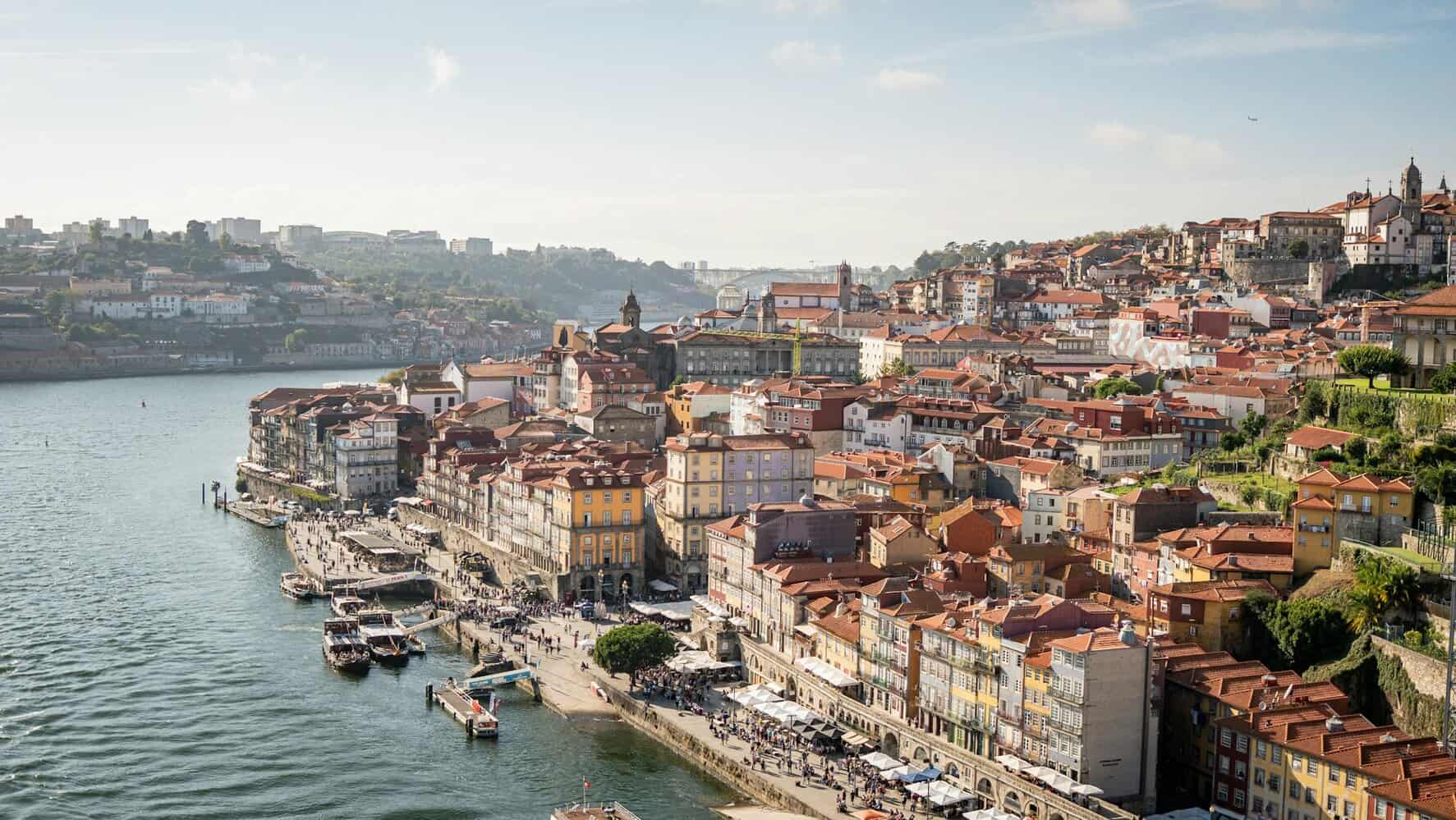
Surprisingly welcoming. People really make an effort to ensure you understand the directions you ask for – and they do it enthusiastically!
What has been the biggest cultural difference you’ve felt?
The food, of course.
What’s your favourite place in the city of Porto?
The beach.
What advice would you give to other international students considering studying at Universidade Católica in Porto?
I wouldn’t hesitate to say that it’s a great place to study. Here, you’ll have every opportunity to deeply explore the field you’ve chosen. I strongly recommend studying at the Universidade Católica Portuguesa in Porto!





Recent Posts

We created the EDUopinions Student Reviews Guide to highlight students' opinions of universities. All of the rankings we produce as part of the Guide ...

The University of Pécs in Hungary ranks among the top 1,000 universities in the world, and in the top 300 in Europe. Located in one of Hungary’s best ...
Want to boost your skills with an MBA, but don’t want to take time out from your job to study – or move abroad? An Online MBA means you can study the ...
North-West University is globally recognised for its strong teaching and research; it is ranked seventh in Africa and among the top 1,000 ...