
Some career changes start with a spreadsheet of pros and cons. But Ukrainian student Sofiia Medvedska’s started with a dream.
“I was at a boiling point when I didn’t like my job; I was already finishing my bachelor’s degree. I didn’t want to continue doing something that brings money but zero pleasure, where you feel some development but no internal personal or intellectual growth,” she explains.
“I was just choosing between a few countries, and in my dream, I realised I was sailing to Spain, and then I stepped onto the shore. And in the morning, when I remembered this dream, I decided that, well, I needed to apply and see what else was there.”
After years working as a financial consultant in Slovakia, she was ready for a new experience: sharper business skills, a new country, and meeting new people.
“I saw gaps in my professional ethics, a lack of strategic understanding, and a lack of understanding of how the structure is organised and how people with different character types and mindsets work in one team,” she explains. “
Her search led her to Advantere School of Management’s Master in International Management (MIM) in Madrid. In this Q&A, Sofiia talks us through what drew her to the programme, the hands-on corporate projects she completed during her studies, and what it’s really like to study, adapt, and build a new life in Spain as an international student.
Why did you choose Advantere School of Management over other schools?
I applied to several business schools. One day I received an email inviting me to an interview at Advantere School of Management with a very pleasant woman named Yan, and she treated me as friendly and kindly as possible. She immediately explained what the process entailed; she warned me right away that there would be several recruitment rounds and that there would be tests. At the same time, she explained what my further steps in Spain would be if I got accepted.
I didn’t feel like just another recruited student; she made it clear right away that this is a school, that it is very small, and – well, not everyone can get in. But she sincerely wished me luck, and before every test she explained what it would be like and how to prepare for it. She always supported me and always asked about my results. I perfectly remember calling my family after talking to her, and my family cried from joy that some woman was supporting me with my admission to Spain.
I didn’t completely believe [Advantere’s] website because everything looked too good. But besides looking visually appealing online, it has an amazing, very comfortable, small campus with a metro station right there. The staff is amazing and welcoming.
What is the learning style like at Advantere School of Management?
All the tasks were highly interactive; every student was given the floor, and everyone got to make their contribution. We had a very flexible, interesting, rich conversation with real-life examples from practice, from the personal experience of both the teachers and the speakers who came to our university.
What kind of hands-on projects did you work on during your MiM?
Everything started with the perfume brand Guerlain. We were given a secret task for a product that hadn’t even hit the market yet, to launch it in Spain. It was insanely cool.
What’s even cooler is that we worked for the BMW MINI brand, and there we built entire platforms using artificial intelligence that you could click on and scroll through.
Afterwards, actually showed this work to the real developers. We presented both the first and second brands directly to the people who manage them. There were some engineers and people living in France who are developing these perfumes.
It’s very cool that, besides doing the analysis and having very cool tools that help and greatly speed up your time, you’re also constantly doing something new. Overall, my understanding of what real strategic marketing is, what product development is, how websites work, how to sell all this, and how to defend this work increased.
We also worked with Carifood. They sent us to the factory where all the food is made and all the products for catering are prepared, and then they told us how it is all delivered, who their clients are, and so on. They even let us taste their products – it was great that they immersed us in the details.
I liked this project very much. We eventually presented it in Washington, and the jury praised us highly.
When you just make a presentation about something without understanding it from the inside, the work turns out dry, not real, and you somehow feel it won’t bring much benefit. But when you communicate from the inside with people, from the inside with professionals, with clients, with workers in this industry, you somehow start to value the product more and somehow want to change their strategy so they can develop much better on the market – you want to give them a better future, you want to invest yourself in it.
What did you learn during the project that you feel you couldn’t have absorbed in a traditional lecture or by studying cases?
I learned to work with many tools related to artificial intelligence and data analytics; I improved my Excel skills; I learned to create websites; and I learned to make stronger, more stylish presentation slides in a very short time. And I learned to work more quickly with all the tools I already knew how to use.
But the most important achievement for me is probably not so much the technical skills as the social ones. When you are in a group with over 15 nationalities, and everyone has absolutely different accents, different ages, and different backgrounds, it is an insane experience that leaves a very strong mark on you that you will never forget in your life.
When you just work within your own culture, within your own language, you might miss some details. When everyone is so unique, when everyone is so interesting, making their own interesting conclusions, making their own contributions, you see that the project develops non-linearly, along a very interesting, beautiful, and very cool curve.
There are so many different points of view that we examine any problem under a microscope immediately from many angles, and we even came up with new solutions that someone might never have thought of. It’s like some collective Megamind is formed.
What support did you receive from the Advantere’s Career Services team?
Every student is provided with their own special personal career mentor whom we can communicate with after graduation. I got a man who worked in retail and then transitioned to HR. In general, this man specialises very well in the Spanish market; he analysed my strengths and weaknesses, looked at my resume, and gave me a lot of useful practical advice that I applied.
Besides the mentor, we also had a woman named Patricia [Employability, Career Services and Talent Management Director] who was responsible for preparing us. And by the way, Xenia as well, and Juan [members of the Employability team]. Anyway, they helped us prepare for interviews: what the right questions are to ask, what you should say about yourself, how to present yourself.
There were a lot of masterclasses on how to properly write your resume; they reviewed our LinkedIn profiles, gave us practical advice, provided many PDF guides, and also useful links for inspiration on building a personal brand. They also arranged a photoshoot for us, where we got professional photos that we put on LinkedIn, and honestly, they turned out simply amazing.
How did the Careers team prepare you for life after graduation?
Advantere very often invites speakers with completely different backgrounds to share what they do in such high positions. Students who graduated from this university a year or two ago came to share how they found a good internship in consulting or another field. It was very comprehensive, very practical, and very interesting.
We also had a career fair at the very beginning of the year. I perfectly remember how they prepared us on how to communicate with these people, how to make ourselves known, that we needed to print a proper resume, that after the career fair we should write a thank-you note, remind them of ourselves, and apply for a job.
For many international students, it was very difficult to learn Spanish, or they didn’t know it at all, and our university immediately, literally with a snap of their fingers, organised Spanish courses for us several times a week. We went, studied with a tutor, they split us into two groups, and we studied the language to integrate into the Spanish market (for those who want to, of course).
We all perfectly understood that we bear responsibility for our choices, and no one will bring us ready-made vacancies on a silver platter to apply for. But sometimes, surprisingly, they sent us ready documents, Word tables, where you could sort by application time, countries, potentially select the niche you want to work in, and everything was described very precisely; you could apply even that way. That is, besides our own job search, they also provided this kind of help.
It’s exactly because of this that I like this university so much, because it’s enough to ask just once, and they pay attention to you; they hear your voice, your wishes are fulfilled, and you always feel supported. Especially in such a difficult task as job hunting, especially when the country is completely new to you.
In my case, I am personally very grateful that I gained basic Spanish language skills, and that I realised that ultimately I want to stay here.
What is it like studying in the same classroom with people from so many different countries at Advantere?
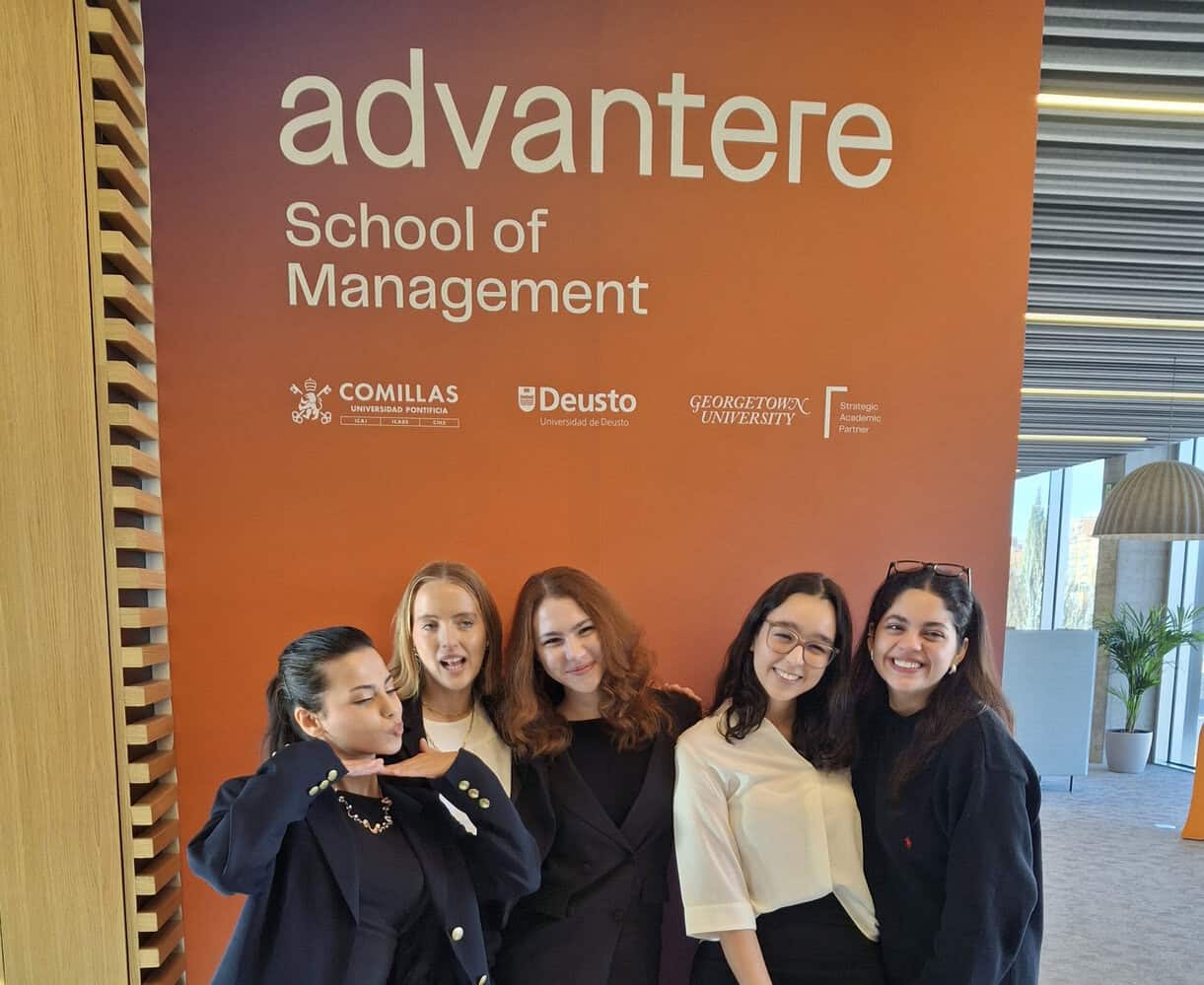
The student selection team did a simply excellent job because I probably encountered the greatest amount of diversity in my life.
It was an unforgettable experience; in its own way quite challenging, because everyone had an absolutely different character, different ideas of what is right and wrong, and everyone had their own opinion. At first, it was a little hard to find my voice because there were no people of my nationality. But here, we were all so different that we had to accept each other.
How has this influenced your mindset or working style?
I became convinced of how huge and diverse our world is and how many beautiful thoughts exist in people. Everyone was special, beautiful, smart, capable.
Of course, we sometimes debated in classes, and it simply didn’t end even after classes; outside of school, we could also gather together in a cafe and discuss how different we all are, our values, worldviews, and traditions.
Advantere actively supported inclusion. We had a ‘Bring a bite’ event, where each of us brought national food from our country, which was very interesting and insanely tasty, and it brought us very close together.
What is it really like to live and study in Madrid as an international student?

I am a Ukrainian who had never been to Spain before, and of course, I faced a lot of problems here. Actually, after meeting two Nigerians at my university, we wrote our master’s thesis on this topic. We created a project on student integration into Spain, avoiding all the mistakes we faced.
I had to adapt to the culture of people eating very late and also always arriving late. At Advantere, I felt like the Queen of early arrivals because I always arrived super early. Even though I lived two hours away from my university, the Spanish and other European students arrived either on time or much later than they should have. But again, the norm is relative, and time is also relative!
A small culture shock that is not entirely related to my Master’s degree but is a highly integral experience of my life is that people here can study all day and then immediately go clubbing and party until the morning as if they aren’t tired, and then go to lectures normally again – and they can do this several times a week. I don’t know where they get so much energy, but the Spanish surprised me with this a lot every time. Actually, it made my experience living in Spain much more fun and cool.
By the way, the Spanish themselves praise you for any effort, for any attempt to say at least something in Spanish. I think this is amazing because I really needed this support right then, and it contributed to my good mood and my language development.
How have you changed since starting at Advantere? What skills have you developed and how have you changed personally?
I have become much more confident in myself, and my English has improved. I started speaking it much better and being more open. I learned to introduce myself to people and learned to defend my point of view. I learned to listen to people, and I learned to understand them regardless of various problems.
Since this is already the second country that I’ve moved to, I have become even more independent. I learned the laws from the inside out, and I got used to new prices. I got used to the new cuisine. I got used to the new climate. That is, I have become even more adaptable and calmer.
I became like this because everyone here has quite a relaxed lifestyle. There’s enough time for everything – people manage their time very competently without rushing anywhere. So this also left a positive mark on me.
What would you say to someone who is still undecided about applying to Advantere or the MIM programme?
I cannot influence another person’s choice, but I would sincerely share my experience about how well I was treated, how much knowledge and career opportunities I received, and how much practical experience I gained.
Regarding the management program, you need to understand that it is a very active, insanely intense program. There will be a lot of travel, there will be a lot of work, especially group work, and your brain will sometimes hurt from the amount of conversation in English, from the amount of everything happening.
What should students know before starting a Master’s programme at Advantere School of Management?
You shouldn’t compare yourself with people who constantly rush for leadership positions, because leadership comes in absolutely different forms. This is perfectly explained at Advantere and can be perfectly seen in real life and in the cases we studied.
You need to have your own personal goal or dream that you are moving towards because, without goals, it is very difficult to go through such trials, very difficult to travel so much, very difficult to switch between so many projects and groups.
Finally, it is absolutely normal not to find an internship or a job in the first months, because many started finding internships closer to the end of our studies, and some are still looking. And again, everyone has their own individual path – you also need to treat this with understanding.
By the way, the most interesting advice is probably to know as many languages as possible. This will generally be useful in life because language opens many doors. And when you speak with someone in French, with someone in English, with someone in Arabic, it’s an insanely amazing experience because you get to know people as more real and more authentic.
Conclusion
Looking back, Sofiia describes her year at Advantere as one of the best experiences of her life — not because it was easy, but because it stretched her in exactly the ways she was hoping for.
Between corporate projects, the career support, and a classroom that spanned more than fifteen nationalities, she found the self-confidence and knowledge that she needed to move forward in her career.
Her advice to anyone considering the program is simple: know your motivation, protect your energy, and stay true to who you are.
“Now I can hold conversations on deeper, more interesting topics. I started understanding the field of artificial intelligence; I mastered new tools. Overall, I feel that my value as a person and as a professional has grown immensely. At least, I now feel this is my home.”



Recent Posts
The Times Higher Education World University Rankings 2027 are here, but there's something missing from the methodology – the students themselves.
...
– While an exciting curriculum, vibrant location, and busy student life are all important parts of your study abroad experience, it’s just as ...
Researchers in agricultural science solve some of the most pressing challenges of today’s society – food and water scarcity, crop damage, land ...
NHL Stenden University of Applied Sciences is among the best applied sciences universities in the Netherlands. The Dutch website Keuzegids ranks NHL ...