
Are university rankings still relevant? It’s a question that arises every year when organisations such as Times Higher Education (THE), the Financial Times (FT), and QS release their annual university rankings.
In recent years, some high-profile universities have opted out of popular rankings tables altogether. At the same time, initiatives like More Than Our Rank encourage universities to highlight their unique strengths, independent of their ranking results.
What’s most striking about traditional university rankings is that, very often, the opinions of one major stakeholder are absent from the methodology: students themselves.
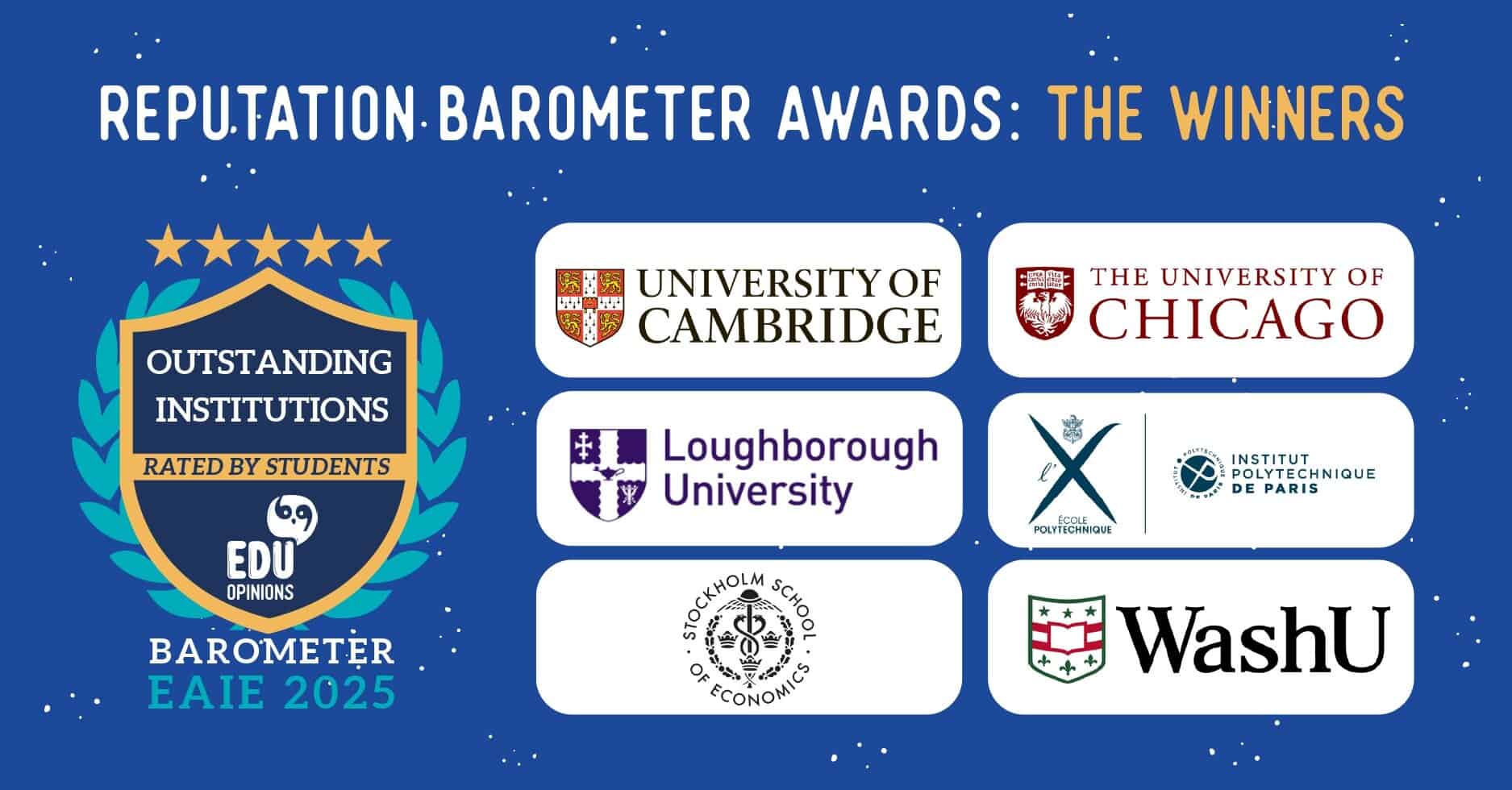
At the 2025 Annual EAIE Conference in Gothenburg, Sweden, we launched the inaugural EDUopinions Reputation Barometer Awards, bestowing the title ‘Outstanding Institutions: Rated by Students’ on six global universities.
These institutions weren’t connected by their place in traditional rankings tables (though they all do appear on established rankings), but by their overall positive digital reputation – how students speak about them online.

How does the Reputation Barometer work?
To evaluate an institution’s digital reputation, we built an in-house AI model to analyse student discussions online.
We analysed discussions on four prominent social review websites:
- Quora
- EDUopinions
By including both formal review platforms (Google/EDUopinions) and informal ones (Reddit/Quora), we ensured that our sentiment analysis reflected the diverse experiences of students.
We evaluated discussions across eight categories: facilities, professors, location, student life, internationality, value, accommodation, and career prospects.
The resulting sentiment analysis was categorised as either negative, neutral, or positive, and given a percentage score.
By comparing the ratio of positive to negative sentiment, we can see which institutions are well-regarded by students, based on current online discussion.
Schools also received a percentage score for each of the eight indicators, offering further insights into areas of strength and weakness.
What if my institution doesn’t have reviews on EDUopinions?
Our sentiment analysis can still provide relevant results without available EDUopinions student reviews. The scores we provide are aggregated based on the three other sources (Google, Quora, Reddit), which, combined, offer insights from tens of thousands of students.
Does the Reputation Barometer only consider star ratings from EDUopinions reviews?
Our AI model evaluates the sentiment of each written review on our site, not the star ratings provided. In this way, it offers a more accurate picture of how students feel about your university, without the subjective influence of star ratings.
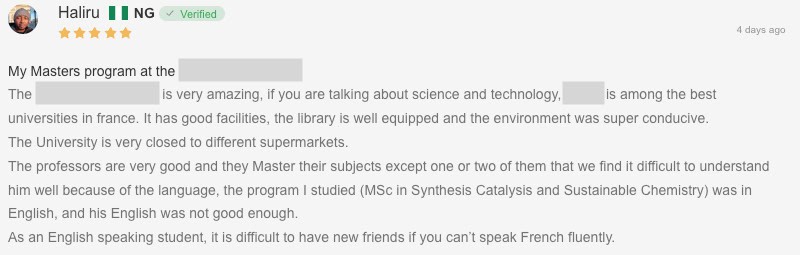
In some cases, as shown in the image below, a student may rate their institution five stars, but in their written comments, they may mention some negative aspects of their experience. Our sentiment analysis ensures that we gather the whole, unique experience of each student to evaluate the university’s reputation.
What is wrong with traditional university rankings?
Numerous studies have found that the university decision-making process is multifaceted and highly individualised. Some of the most common factors in the university choice process are costs, institutional reputation, facilities, location, and interpersonal recommendations. Additionally, students consult a wide variety of touchpoints when gathering information, ranging from university websites to family recommendations and formal factors such as accreditations.
A 2022 survey of 780 prospective undergraduates in the UK found that the most common responses to the question ‘Which of the following are important to you when choosing universities to apply to?’ were:
- Course content (70%)
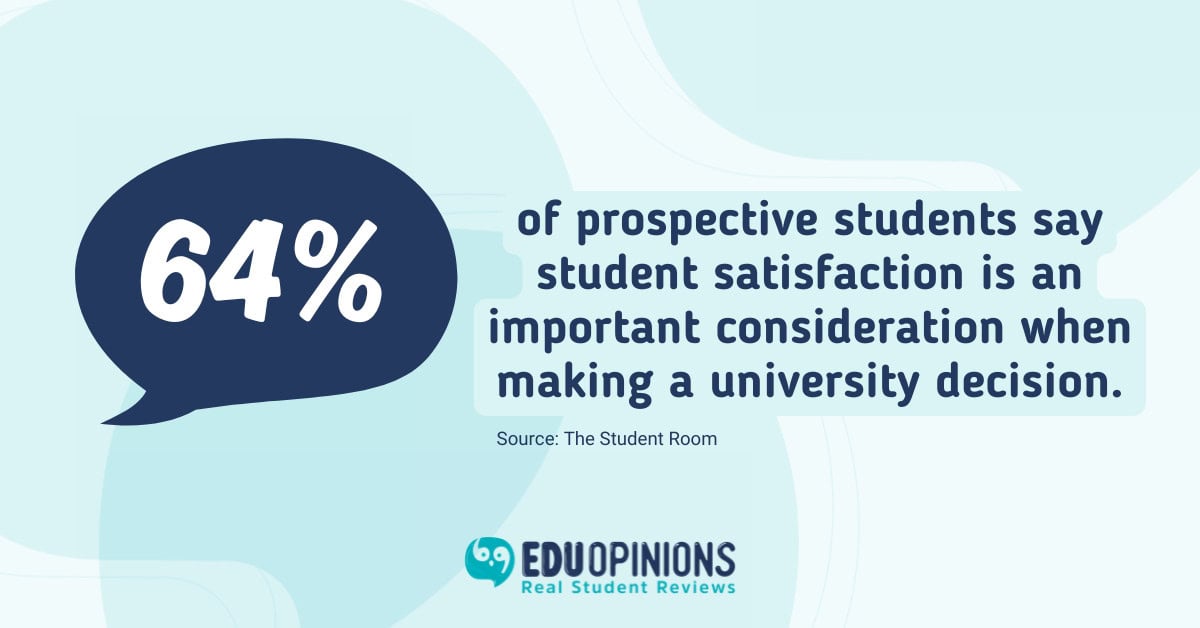
- Student satisfaction (64%)
- University atmosphere (63%)
Another UK student survey, conducted in 2025, revealed a different set of factors: affordability was ranked as the most important factor (33%), followed by teaching quality (26%) and graduate job prospects (25%).
However, the critical finding in this survey was that, while just 15% of students rated social life as the most crucial factor, this was still more than research output or league table scores.
Traditional university rankings employ complex methodologies. The Times Higher Education rankings, for instance, evaluate 18 separate factors across five pillar areas: teaching, research environment, research quality, international outlook, and industry. These factors are weighted according to the THE’s opinion of relative importance.
Notably, none of these factors takes into account the experiences and feedback of current students or recent graduates. In fact, a significant element of the THE methodology is the annual Academic Reputation Survey, which seeks opinions from select academics on the institutions they perceive to be the best for teaching and/or research.
While other elements of the methodology may be of use to prospective students, such as student/staff ratios and the percentage of international students, the majority are unlikely to have a direct bearing on a prospective student’s decision-making process.
How is the EDUopinions Reputation Barometer different?
Unlike traditional university rankings that concentrate on the experience of academics and the research environment, the EDUopinions Reputation Barometer focuses on genuine student opinions and emotions.
While undoubtedly a subjective measurement, our AI model produces an objective analysis of online discussions, thus providing a unique perspective on university perception and reputation. Fundamentally, the Reputation Barometer analyses what truly matters: the feelings and emotions students express in their reviews and online conversations.
Consequently, it provides institutions with a highly influential evaluation of their digital reputation, based on feedback from their most important stakeholders: students.
The inaugural winners of the Outstanding Institution accolade, announced at EAIE 2025, were:
- École Polytechnique Paris
- University of Cambridge
- Washington University in St. Louis
- University of Chicago
- Stockholm School of Economics
- Loughborough University
Launching the EDUopinions Reputation Barometer
Following the successful launch of the Reputation Barometer at EAIE 2025, we will release our first comprehensive sentiment analysis report, the EDUopinions Reputation Barometer: France 2025. The results will recognise those French universities that are making the strongest emotional impact on students, based on genuine online discussions.
Keep an eye out for the release of the EDUopinions Reputation Barometer: France in December 2025.


Related Posts :






Recent Posts

We created the EDUopinions Student Reviews Guide to highlight students' opinions of universities. All of the rankings we produce as part of the Guide ...

The University of Pécs in Hungary ranks among the top 1,000 universities in the world, and in the top 300 in Europe. Located in one of Hungary’s best ...

Want to boost your skills with an MBA, but don’t want to take time out from your job to study – or move abroad? An Online MBA means you can study the ...

North-West University is globally recognised for its strong teaching and research; it is ranked seventh in Africa and among the top 1,000 ...