Hankuk University of Foreign Studies vs Canterbury Christ Church University - CCCU vs Westcliff University vs Le Cordon Bleu Paris vs Korea Advanced Institute of Science and Technology - KAIST
Side-by-side comparison from 53 verified student reviews. Scan one row at a time — winners are highlighted
- +Vibrant international atmosphere and student activities
- +Supportive professors and well-regarded alumni network
- +Focus on internationalism and exchange student support
- +Welcoming campus environment and good facilities
- +Helpful staff and diverse academic programs
- +Strong student welfare and inclusive community
- +US curriculum in Nepal
- +Inviting and warm environment
- +Hands-on experience and entrepreneurship focus
- +Exceptional teaching quality from passionate, experienced instructors
- +Unmatched precision, emphasis on quality, and professional skill development
- +Welcoming environment, strong support, and valuable alumni network
- +High-quality academics and challenging curriculum
- +Excellent facilities and research opportunities
- +Financial benefits and student support
Nothing to show
- +Supportive professors and excellent research facilities
- +Diverse extracurricular and cultural activities
- -Students dislike administrative & management issues.
- -Students dislike outdated facilities.
- -Students dislike lack of clear communication.
- -Administrative & management issues cause significant disruption.
- -Administrative and management issues are a recurring problem.
- -Outdated facilities and lack of resources are a significant drawback.
- -Poor communication and unclear expectations cause frustration.
- -Administrative and management issues cause frustration.
- -Outdated facilities and lack of modern resources are disappointing.
- -The curriculum feels irrelevant and disconnected from real-world needs.
- -Administrative and management issues are a major source of frustration.
- -Outdated facilities and lack of resources hinder learning.
- -Poor communication and unclear expectations cause confusion.
Nothing to show
- -Administrative and management issues cause significant frustration.
- -Outdated facilities and resources hinder learning.
- -Lack of adequate support and communication from staff is a persistent problem.
This institution receives top marks for student life, achieving a perfect score. It also scores well in its academic offerings and perceived value for money. However, its facilities, location, and accommodation all received average ratings, indicating potential areas for improvement. Internationality is also rated moderately.
This institution demonstrates considerable strengths in its **Facilities** and **Professors**, both receiving high marks. **Student Life** and **Accomodation** are also rated positively. Areas that received less enthusiastic feedback include **Internationality** and **Value**. **Location** falls somewhere in the middle, reflecting a solid but not exceptional standing.
This institution demonstrates a strong academic environment, evidenced by an excellent rating for its professors. Student life, location, and internationality also receive favorable scores. However, facilities and accommodation represent areas for potential improvement, as indicated by their lower ratings. The overall value is considered good.
This university demonstrates exceptional strength in its **location** (4.7), **professors** (4.6), and **internationality** (4.6). Students are particularly impressed with the quality of instruction and the global environment. Conversely, **accommodation** stands out as the lowest-rated area at 3.0, suggesting room for improvement in this aspect. Student life and value for money also received moderate scores.
Examining the provided ratings, the university demonstrates notable strengths in its **Facilities**, achieving an impressive 4.75. **Value** also scores highly at 4.05. Conversely, **Internationality** presents the most significant area for improvement, with a rating of 2.55. Other categories like Professors, Location, Student Life, and Accomodation fall within a moderate range, suggesting a solid but not exceptional experience in those aspects.
Nothing to show
Overall, this institution garners very positive feedback. It excels particularly in its **facilities, professors, student life, and accommodation**, all receiving perfect scores. The university also scores well in **internationality and value**. Its **location** is the sole area that received a slightly lower, though still strong, rating.
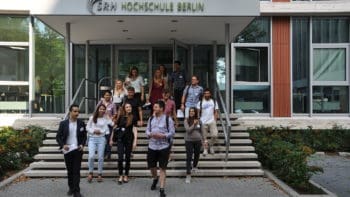
All 6 reviews are positive, averaging 4.33/5 stars. Students highlight the welcoming atmosphere, enjoyable campus, and supportive international student organization, with excellent experiences as exchange students.
With a 4.21 average rating, ~93% of reviews are positive, praising campus, facilities, and inclusivity. A small percentage (~7%) noted minor issues with event attendance and parking.
With an average rating of 3.5/5 and ~100% positive feedback, students highlight the inviting environment and hands-on learning opportunities, including entrepreneurship and networking. No negative reviews were recorded.
Students highly praise the exceptional quality of teaching and knowledgeable instructors. Facilities are noted as impeccable and the learning environment welcoming, contributing to professional and personal growth for ~100% of reviewers.
Nearly all reviews are positive, highlighting good professors, peers, and overall satisfaction. The average rating is 3.9/5.
Nothing to show
The single review is positive, rating the university 5/5. This reviewer highlighted supportive professors and excellent research facilities as key strengths, along with diverse extracurricular activities. There are no negative reviews.
As an exchange student it was a little difficult for me, at least at the beginning, to comunicate and find locations inside the Campus. The majority of the staff (unless they were in the International office) did not speak English, so you need to fond korean classmates/friends that will help you with that (they are really nice!). Out of that I really liked the classes taken there. Unfortunately, my classes where not given by any korean proffesor; only foreign ones. But sitll I really liked them. The knowledge is wide and it becomes easy in participating at sessions. Besides, the self-studing method becomes the best tool to improve your knowledge and have good grades!There are also a lot of team work which gives the result of many opinions and points of view that are fun to work with. All of the classes where given in the new buliding and that was really good. But all the rest of the buildings had an old infraestructure. Maybe they could invest and upgrade those buildings. The location of the Seoul Campus is really good because it is near the subway and if the cafeteria food does not suit for you, you will have a lot of options around it. In general I really liked my experience at Hankuk University of Foreign Studies.
Nothing to show
Nothing to show
I really enjoyed my time at LCB! I've found that my skills when I entered the work force were much higher than others. I think though there was a big portion missing in recipe development and composition. True- we did learn it through memorizing the recipes, but we really were missing classes on how different ingredients affect the final textures.. how you can change them... etc. That I still am not an expert in .. and I create recipes! Ouf! Also, I don't know if you still do a month of sugar work... but that really wasn't necessary and should be either cut or minimized to just 2 lessons. It's such a niche skill to know that I would have really preferred more technical skills. I loved the old location. The "rumors" I'm getting about the new location are that it's not as good, unfortunately - that i's become more of a money focused/marketing machine. I really hope that this image can be fixed as I love LCB and enjoyed my time there! Oh also - there should be more help for students to get jobs and featuring old students accomplishments - from cookbook launches to new bakeries so that current and old students can support them.
I did my undergrad in Electrical Engineering and Computer Science here, graduated in 2022. Pros: good research, great facilities, good programmes, completely free tuition, inexpensive accommodation + allowance, flexibility in course choice, wide material coverage, all pros of Korea (e.g. safety, convenient travelling) Cons: strict attendance, some lectures of poor quality, competition and relative grading, hard to make local friends/connections, all cons of Korea (e.g. no English whatsoever outside campus) The school is very much research-oriented, with lots and lots of great resources and facilities to do research. So if you want to do a research graduate or post-graduate course here and you like a particular programme, this is definitely a good place for you. That said, most profs are good researches, not necessarily good educators. University-wide policy is that every course essential for degree completion is taught in English. Thus, with a few exceptions in Humanities, and some very obscure courses, you won't have to learn Korean. The professors had to learn English though. And despite that most of them have lived for a certain period of time in the US, some really struggle to teach in English. In worst cases it will come down to the professor simply reading the slides in the lecture. Couple that with a strict attendance policy, you get a pure torture. On a positive note, most of the newly coming young profs are not like that. Lab/research experience is also very different across different professors. Some are complete grind where you only do what professor tells you to do, and end up working 55+ hours a week. Some are nice and cheerful productive environments where you can even have your name on the authors list of couple papers being an undergrad, and enjoy the research process throughout. The courses choice is wide and the programme is really flexible about what you do. This is especially true for larger departments like the School of Electrical Engineering - which is in fact, called "School of Electrical and Electronic Engineering" in Korean, and I don't even know why the word Electrical is even there - you won't get to learn anything like High Power Electrics. Depending on a course, the amount of theory and hands-on differs significantly from completely theoretical courses to labs with almost zero theory taught. Overall, I would like to get slightly more hands-on experience, but it was alright. The material coverage is on a very good balance in between breadth and depth. Perhaps, it's trying to get both breadth and depth, which results in a relatively high workload. And this high workload is something that is partly fuelled by all grading being done relatively. For example, to get an A, you don't have to score 90% - you have to be roughly above avg + 1 stddev of the normalised score distribution in your group. This encourages some instructors and assistants to either make the workload extremely high, or make the exams extremely difficult just for the sake of difficulty, or both. Yet, if you don't care too much about your grades, but still keep studying, it's hard to fail a particular course. Social life is something that is difficult to have in KAIST if you are an international student. 90% of the students are Korean, and most of them feel shy to/don't really want to reach out to international students. Reaching out to those people yourself will rarely help. Out of the remaining students most are not too much into socialising. What are the chances that you'll like the remaining few? Most clubs are also primarily Korean with all their activities conducted in Korean. Should be somewhat easier if you speak Korean, but not necessarily as easy as it would be elsewhere in the world.
Nothing to show
Nothing to show