
American universities have always been the pinnacle of higher education; seven US universities are in the top 10 in the Times Higher Education World University Rankings. However, our data shows that student ratings of American universities are inconsistent over time. As the country prepares to swear in a new (returning) President, there’s been a raft of analysis on the state of higher education in the United States. The US still has a reputation for high-quality education, but how do external factors change the ratings of US universities?
EDUopinions has been collecting student reviews for universities around the world since 2016. Our reviews explain to new incoming students what the studying experience is really like and what the downsides might be.
Overall ratings form the basis for university ratings on our platform, and by tracking those ratings over the years, we can see how student ratings of US universities have changed.
Comparing this data with global trends in student ratings paints an interesting picture of the state of US education and how international and domestic students view their experiences at US universities.
University Rating Trends: 2017-2024

Between 2017 and 2024, over 50,000 students and graduates left reviews of their universities on EDUopinions.
Although this data encompasses a wide variety of student experiences, including domestic vs. international students and studies in Europe, Africa, the US, and Asia, it’s still possible to consider trends across global higher education.
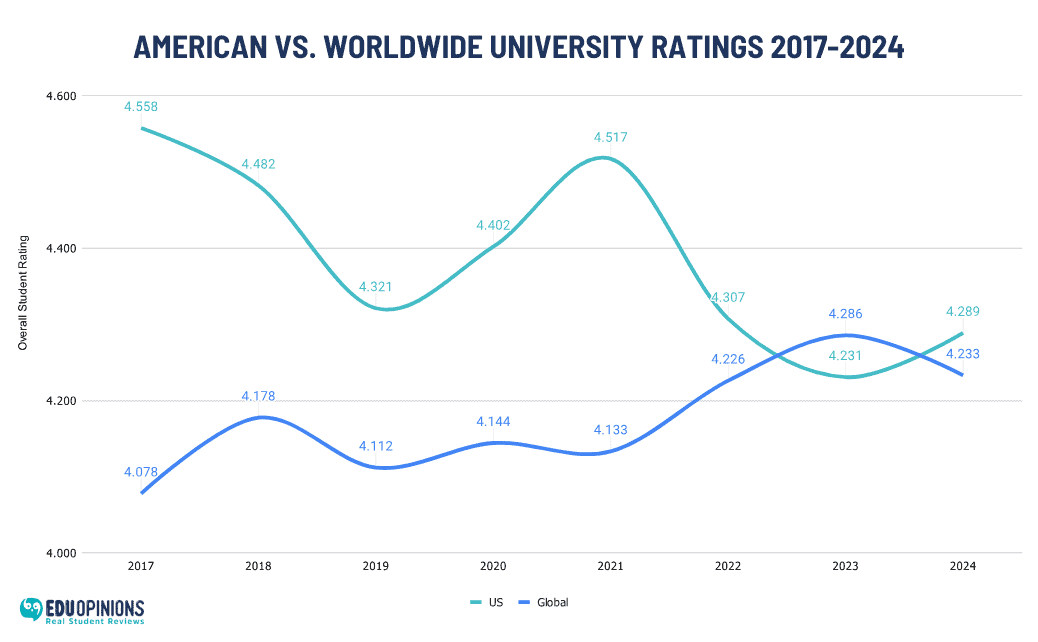
The graph below shows the overall ratings given by students for global universities (including the US) between 2017 and 2024. It provides an extensive picture overview of global education and demonstrates trends that many HE professionals, governments, and publications have pointed out.

For example, the downward trend in global university ratings between 2020 and 2021 illustrates the impact of COVID-19 on students’ university experience. Afterwards, ratings of global universities increase each year as COVID restrictions (keeping students out of classrooms) ease and institutions slowly return to traditional, in-person teaching.
Overall, average university ratings have gradually increased over the last seven years, from 4.08 in 2017 to 4.23 in 2024. This includes a significant increase between 2017 and 2018, which starkly contrasts how universities fared in this period.
How Have US University Ratings Changed?
Generally, US universities tend to achieve high overall ratings, particularly among American reviewers, for whom the US is the most popular destination for their studies. In 2024, the average rating for American universities from all international and domestic students was 4.29, marginally higher than the average rating for all universities this year.
However, overall, between 2017 and 2024, US universities saw a significant decrease in average ratings. Between 2017 and 2019—the first two years of Donald Trump’s first presidency—average student ratings of American universities dropped from 4.56 to 4.32.
This drop is more significant than the decrease global universities sustained during the COVID-19 pandemic between 2020 and 2021.

Subsequently, US universities did not see a rating drop between 2020 and 2021. Instead, average ratings rose from 4.4 in 2020 to 4.52 in 2021, almost reaching their highest average in 2017.
While the period between 2020 and 2021 will be recognised as the COVID year, in the US, it was also the transition period between President Donald Trump and President Joe Biden, who was inaugurated in January 2021. That ratings rose again after Donald Trump left the White House, which may reflect the backlash against international students that marred his first presidency.
Countering that hypothesis is that average ratings of US universities dropped again between 2021 and 2023, rising marginally in 2024.
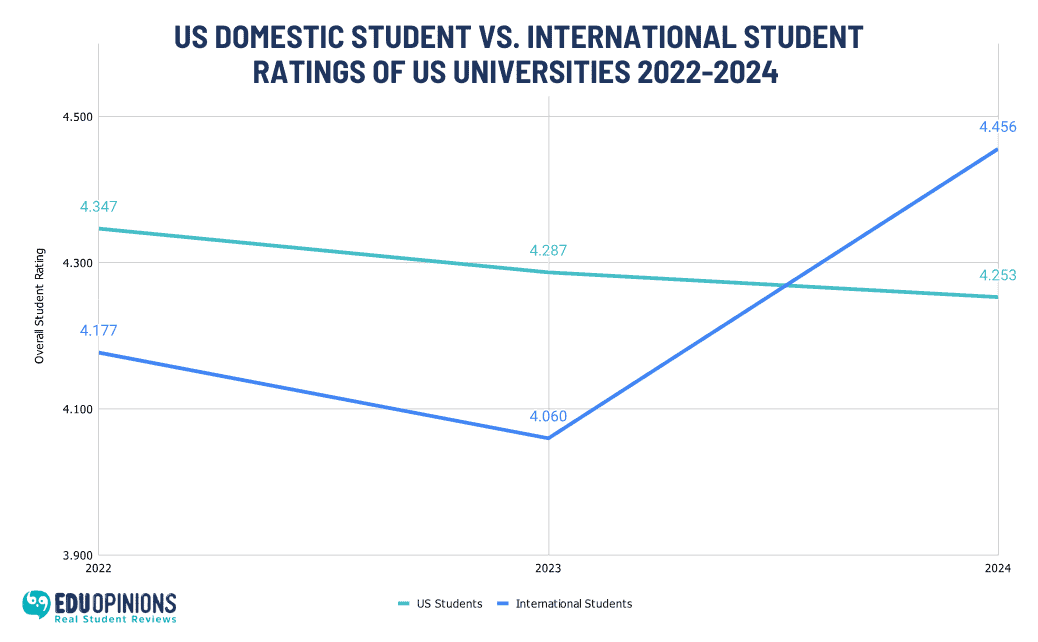
EDUopinions has only been collecting data on reviewers’ nationalities and international student status since 2022, so it’s not possible to consult international student ratings of US universities between 2017 and 2024. However, data from 2022 and 2024 shows that international student opinions of US universities have increased while US student ratings trend downwards.
US Universities vs. Worldwide Universities
The discrepancies between reviews of US and global universities are more visible when directly comparing the above trends. In particular, there is a contrast between the downward trend in student ratings of American universities between 2017 and 2019 and the upward trend of the global trend.
Additionally, it’s clear that US universities experience more significant swings in average university scores than when considering all institutions globally. Of course, global university ratings are based on far more reviews than just for the US. However, they could also reflect American universities’ worldwide reputation and how students feel more disappointed when the experience doesn’t match their expectations.
US Universities vs. European Universities
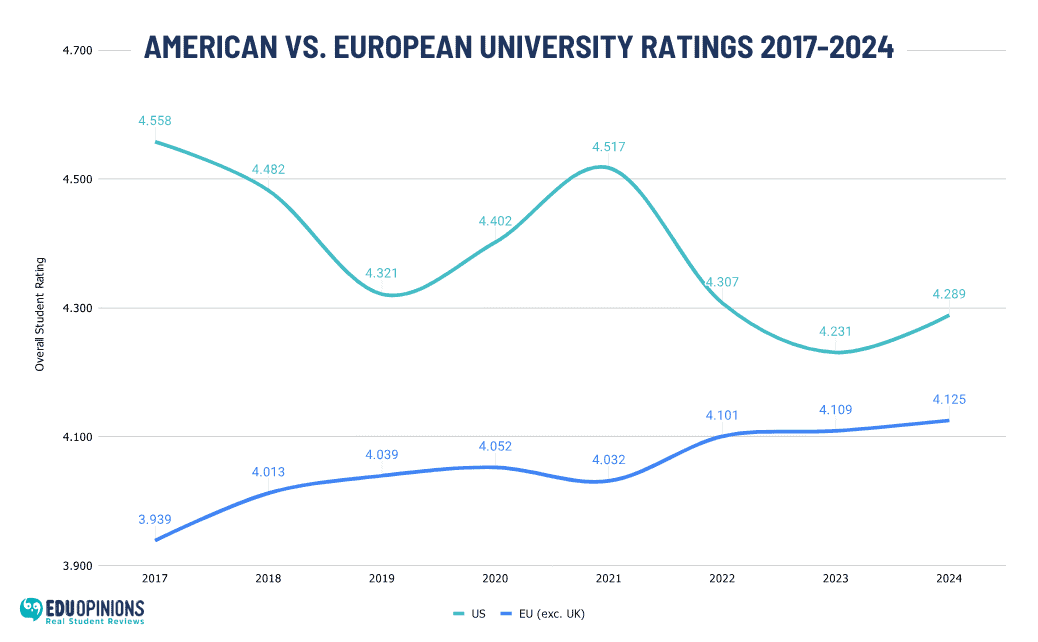
To better analyse American university student ratings, we gathered student ratings from the ten European countries with the most reviews on EDUopinions, excluding the UK. These were Spain, France, Italy, Netherlands, Poland, Germany, Portugal, Greece, Denmark, and Ireland.
As the graph of global university ratings shows, ratings for European universities also increased between 2017 and 2019, in contrast to American universities. The effect of COVID-19 on European university ratings was also less pronounced, resulting in a brief plateau before increasing slightly in 2022.
Overall, from 2017 to 2024, average ratings increased very slightly—the downward trend in US university ratings is much more visible.
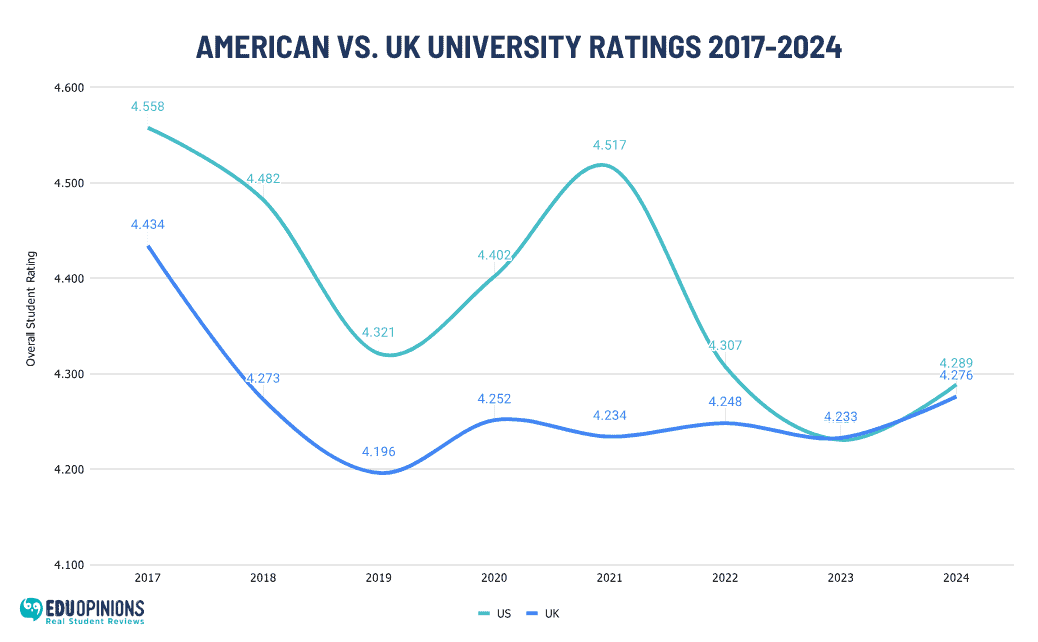
Like the US, UK institutions are also seeing a decline in their average ratings. For example, the same downward trend in US ratings between 2017 and 2019 is visible in UK university reviews from the same period.
This period is significant in the UK for two reasons. First, these were two General Election years, during which immigration was a key issue. Additionally, the Brexit Referendum in 2016 significantly affected the UK’s global reputation among international students and researchers.
Both of these issues may have subsequently affected the ratings of UK universities just as Donald Trump’s presidency between 2017 and 2021 affected US university reputations. Meanwhile, European universities appear to have been shielded from the effects of these political changes, obtaining steadily higher average student ratings over the last seven years.
Conclusion
Many factors can affect student ratings of higher education institutions, including external factors like geopolitical changes. While most student reviewers won’t actively consider these issues while writing a review, the fact that global trends can be mapped onto university ratings demonstrates that factors beyond the principal university experience can affect student ratings.
Global trends are more likely to affect international student opinions. While EDUopinions data on this point is limited, it’s clear that international student ratings can drastically impact overall university ratings for a particular region, as is the case with international student vs domestic student ratings of US universities.
Both US and UK universities are just beginning to recover from ratings dips in the last few years, showing gradual upward trends in 2024. Although it’s difficult to predict how university student reviews might change in 2025, it’s not unlikely that American universities may see another dip in ratings, as was the case during Donald Trump’s first presidency.
Could European universities continue their upward ratings trend as they experience more interest from international students who are shunning US universities? We’ll have to wait and see.

Related Posts :





Recent Posts

We created the EDUopinions Student Reviews Guide to highlight students' opinions of universities. All of the rankings we produce as part of the Guide ...

The University of Pécs in Hungary ranks among the top 1,000 universities in the world, and in the top 300 in Europe. Located in one of Hungary’s best ...

Want to boost your skills with an MBA, but don’t want to take time out from your job to study – or move abroad? An Online MBA means you can study the ...

North-West University is globally recognised for its strong teaching and research; it is ranked seventh in Africa and among the top 1,000 ...