
I was blown away when I saw ChatGPT for the first time in December 2022 – how it wrote grammatically correct text and switched between languages effortlessly.
As an online search specialist, I knew it right away: this would change everything. Although not right away. People need time to adopt new habits. And like most of us, I realised in the days following that the first version of ChatGPT was far from suitable as a search engine.
About three years on, the time has come: we are seeing real changes in people’s online behaviour. So, what’s happening with AI search, and what does this mean for education marketers?
AI adoption among prospective students

It is no secret that students are using ChatGPT and other AI models. For study, but increasingly also whenever they make decisions in other areas of life. A recent survey by INTO University Partnerships found that 17% of recently admitted students reported using AI tools to research study options.
The actual number is almost certainly a lot higher by now. For one, the surveys asked admitted students about how they made their decision a year ago. But also, even when prospective students default to “good old” Google, they will increasingly be exposed to AI overviews at the top of their result page.
A report from Cues.ai, based on web analytics data from around 20 UK universities, found that web visits referred by ChatGPT rose ninefold in 2025. It also noted that these visitors were highly engaged: 36% returned later via ChatGPT, another 15% returned via Google, and the average session duration from returning visitors was over 3 minutes!
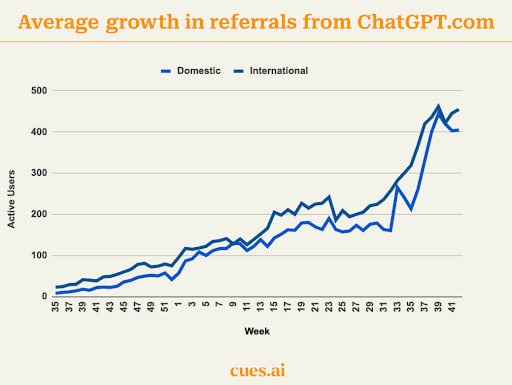
While this growth in AI-referred traffic came from a (very) small base, it is also understated for several reasons:
- Traffic from LLMs such as ChatGPT is hard to attribute.
- People mostly read the answers in the tool – the people who click through on links from ChatGPT, Gemini, or Perplexity are just the tip of the iceberg.
What does AI Search in Higher Education mean for education marketing?
I’m not going to be alarmist here.
A lot of what you’re doing for online and offline marketing is also going to help your institution to get mentioned in AI answers when students are researching their study options.
But a couple of things are changing fundamentally, and fast.
Most importantly, prospective students won’t visit your website as often anymore. Whether they ask ChatGPT, Perplexity, or Google, they are more likely to find the answer right there, without the need to click through to your website – a phenomenon referred to as zero-click search.
This means that if you are measuring your marketing success mostly by website visits or leads from your website, you’ll likely struggle just to keep your numbers flat compared to previous years.
But just because prospective students aren’t visiting your website as often doesn’t mean that they won’t eventually apply – they’re just getting more of their information elsewhere.
So, some of your marketing attention will need to shift to AI tools – whether you’re mentioned at all, and whether the information presents you in the right light.
What are LLMs saying about you?

There is only one way to find out what AI tools are saying about your institution – by prompting them yourself and seeing what they say.
When doing this, you need to realise that LLMs respond based on what they know about the user, so every answer they give is different. There are also endless variations of questions you could ask – you simply cannot track everything.
So, spend some time deciding which types of questions are the most crucial to track for your institution.
Fortunately, there are tools that can help you track; I use Peec.ai. You enter your questions in the tool, and it will prompt several AI platforms every day, track whether you are mentioned, log the answer, and quantify how your visibility and sentiment develop over time.
Setting up tracking and checking it once a week will make you aware of where you’re already mentioned and where your coverage is weak (or even inaccurate).
That will naturally lead to the next step: influencing what AI platforms say about your institution.
How can you influence AI Answers?
As I argue in my book Genuinely Helpful, your institutional website is still the most important lever. It’s the only place on the web that you can fully own and control. AI tools assign a lot of importance to what your website says: it’s simply the most up-to-date and direct source of information about you.
But while your website is an important lever for getting accurate, up-to-date information out into the world, visibility also depends very much on whether you are mentioned elsewhere on the web.
On their own website, every institution will describe itself as “leading”, so when it comes to comparing institutions and programmes, AI tools give much more weight to external sources.
When a prospective student asks ChatGPT for the best logistics-focused MBAs in France, your institution is more likely to make it into the answer if you get mentioned in discussion threads, news articles, and business school rankings on the topic.
What do you think carries most weight, your programme page talking about how the programme is designed to boost employability, or a student’s LinkedIn post about how much they learned during their internship while attending your programme?
Just like with people, you build credibility with AI tools by showing up consistently on multiple platforms.
While your website is the most reliable source for things like admission requirements or programme contents, student reviews or testimonials posted on your website simply aren’t as credible as reviews that are posted elsewhere on the web.
To influence what AI says about you, you need to influence what others say about you – or even get people to talk about you in the first place. That builds real credibility.
How to get people talking about your institution

For people to talk about your institution, you need to have a shareable story that resonates with your target audience.
For example, if you consistently talk about how everything you do is employment-focused, and students experience this during their studies (so it’s not just words), then that’s what they’ll tell others when asked about their experience.
The good news is that this is not as much a budget issue; it’s “just” about alignment. Repeat the same, distinctive message over and over again and, most importantly, back it up with what you do. Over time, your students and the wider world will pick up on it, and when they do, so will AI tools.
Once you have the story straight, invest some time in getting the word out. For example, it’s rare for students to spontaneously write a review of their experience at your institution. You need to proactively encourage them to do so. The people behind EDUopinions have perfected this process – so do consider getting their help!
About Guus Goorts
If you want to stay visible as student journeys shift toward ChatGPT, Google AI Overviews and Perplexity, Guus offers a practical course on AI and search visibility for education.
Related Posts :





Recent Posts

We created the EDUopinions Student Reviews Guide to highlight students' opinions of universities. All of the rankings we produce as part of the Guide ...

The University of Pécs in Hungary ranks among the top 1,000 universities in the world, and in the top 300 in Europe. Located in one of Hungary’s best ...

Want to boost your skills with an MBA, but don’t want to take time out from your job to study – or move abroad? An Online MBA means you can study the ...
North-West University is globally recognised for its strong teaching and research; it is ranked seventh in Africa and among the top 1,000 ...